




The CCTV Security Mistakes That Cost Small Businesses Thousands Every Year
Eight cameras. A working alarm. Still, $11,000 is gone in one night. The thieves cut the lights, and the cheap night vision surrendered to a black screen.
The alarm went off at 2:14 a.m., and somebody logged it, sent an email, and went back to sleep. By 8 a.m., the owner walked into an empty store.
The footage from that exact window was already gone, quietly erased by the DVR’s 14-day loop. Nothing failed all at once.
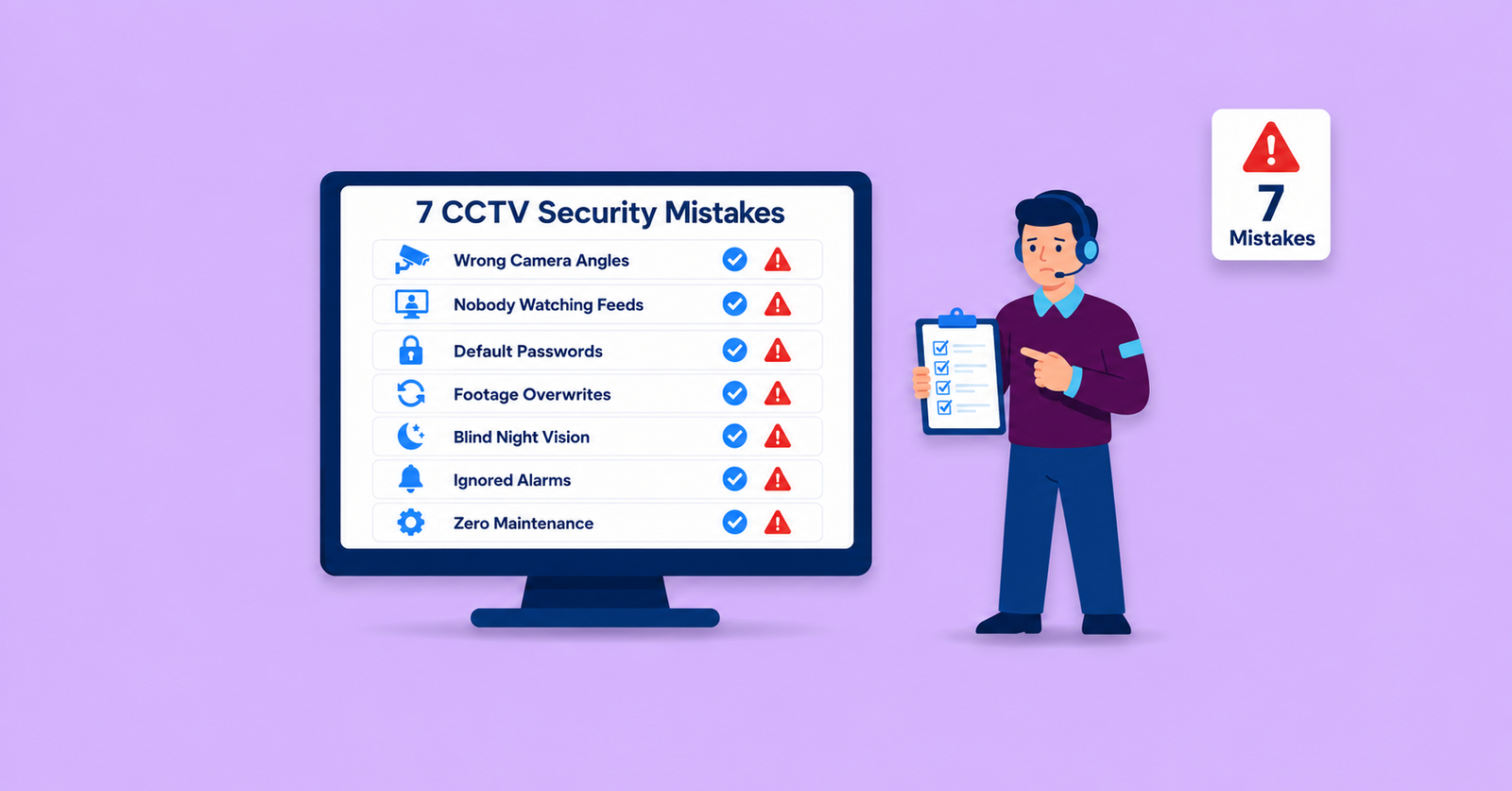
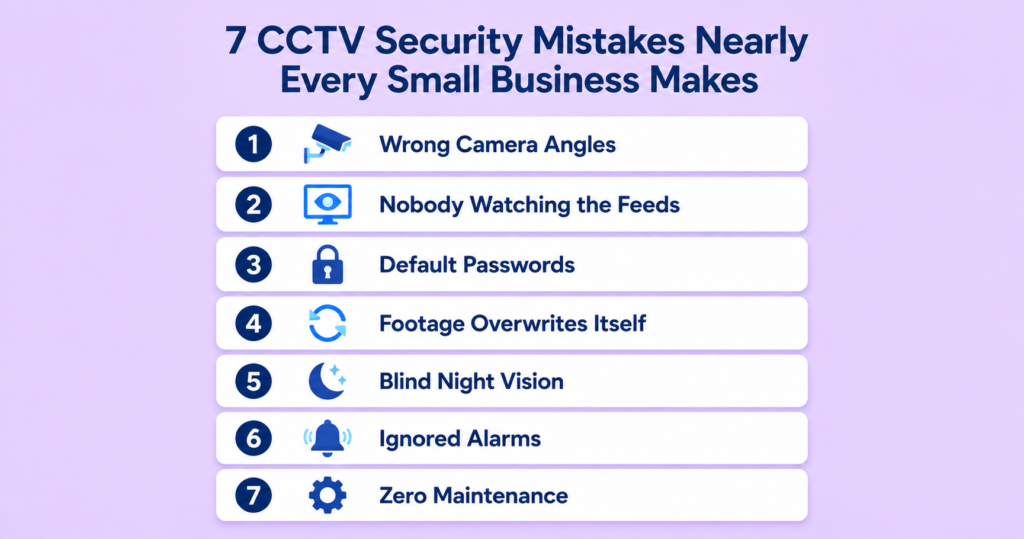
Cameras aimed at the wrong spot, no one actually watching, night vision that could not see, an alarm nobody answered, and footage built to delete itself. Seven small, ordinary oversights, not one dramatic failure.
Burglary and theft remain the second most common claim small businesses file, according to The Hartford’s 2025 claims analysis, and that number has not moved in ten years — these seven mistakes are a big part of why.
Quick Summary
Most small businesses install cameras and assume the job is done. It is not. Seven CCTV security mistakes turn a working camera system into a false sense of protection, and most owners do not find out until the loss has already happened. The average burglary now costs a business $2,661, and police solve only 11% of cases. The camera on your wall records the crime. It does not stop it. This article names the seven mistakes and the fix for each.
Mistake 1: Cameras Pointed at the Wrong Areas
Cameras get placed during installation and almost never move afterward. This is one of the most common mistakes businesses make when installing CCTV cameras, and it compounds over time. But businesses change. Shelving gets rearranged. New doors get added. Stock gets relocated. Six months later, the camera that covered the back entrance points at a storage rack, and the actual entry point has no coverage.
The FBI recorded 779,542 burglaries in 2024, roughly one every 51 seconds. A camera aimed at the wrong wall records none of them. The footage exists, but it shows an empty aisle while the theft happens ten feet outside the frame.
The fix: Audit every camera’s field of view once a year. Walk the space, look at each live feed on a monitor, and compare it against the current layout. If the environment has changed, move the camera to match the space you have now, not the space you had at installation.
Mistake 2: Nobody Is Watching the Camera Feeds
This is the most expensive CCTV security mistake and the hardest for owners to accept. A camera records footage to a drive. Nobody watches that footage until after an incident, when it gets scrubbed for evidence. By then the crime is finished, the criminal is gone, and the footage documents a loss instead of preventing one. This is the first of the CCTV monitoring mistakes that leave a business exposed, and it is the reason most business CCTV systems prevent nothing.
Police solve only 11% of burglaries, according to FBI clearance data. That means footage handed to police after the fact leads to a resolution in fewer than one in eight cases. The camera that recorded the crime rarely helps recover the loss.
The fix: Put a live security monitoring layer behind the cameras. A trained operator watching the feed in real time sees the breach as it happens and responds within seconds, which is the difference between a prevented break-in and a police report nobody can act on.
Mistake 3: Default Passwords on Every Device
Installers set up cameras and DVRs with default logins like admin/admin and frequently never change them. The owner does not know the defaults exist. That leaves the entire system accessible to anyone who tries the factory password, which is published openly for every major camera brand.
An unsecured camera network is not just a privacy problem. A compromised DVR gives an intruder a live view of the business, its cash handling, its schedules, and its blind spots, which is reconnaissance for a physical break-in.
The fix: Change the default password on every camera and every recording device the day the system goes live. Use a unique, strong password for each device, and update the firmware to close known security holes that factory settings leave open.
Mistake 4: Footage Overwrites Before Anyone Reviews It
Most DVR and NVR systems ship with a recording loop set between 7 and 14 days. When the storage fills, the oldest footage is written over automatically. A business that discovers a theft three weeks after it happened finds the critical footage already gone.
This is the CCTV footage mistake that voids insurance claims. Burglary and theft are the second most common small business insurance claim per The Hartford, and a claim with no footage is a claim the insurer can dispute or deny.
The fix: Set the retention period to a minimum of 31 days. Back footage up to cloud storage instead of a local DVR so a stolen or damaged recorder does not take the evidence with it. A monitoring provider that tracks storage capacity prevents the silent overwrite from ever happening.
Mistake 5: Night Vision That Cannot See Anything
A camera that produces sharp footage during the day can produce a useless black or washed-out image at night. Cheap infrared LEDs fade at close range and disappear at distance. Dirty IR windows scatter the light. The result is clear footage during business hours and nothing usable overnight, which is exactly when break-ins happen.
Nonresidential burglaries fell 18% in 2025 according to the Council on Criminal Justice, but the ones that still happen overwhelmingly happen after dark, which is exactly why night vision monitoring matters. A camera that goes blind at night is blind during the only hours that matter for burglary.
The fix: Test every camera’s night vision at the actual distances it needs to cover, not against the spec sheet. Clean the IR windows, clear away spider webs on outdoor units, and replace any camera whose effective night range falls short of the area it is meant to watch.
Mistake 6: The Alarm Triggers But Nobody Responds
An alarm that sounds a siren and sends an email is not a monitored alarm. It is a noise machine with a notification feature. When the alarm triggers at 2 a.m. and the only response is an email to a sleeping owner, the police are never called, and the criminal operates freely.
Businesses collectively pay over $100 million a year in false alarm penalties, according to the Center for Problem-Oriented Policing, and false alarm fines average $150 per incident across US cities. A system that generates penalties but not responses is the worst of both outcomes: it costs money and prevents nothing.
The fix: Use verified alarm response, where a real-time security monitoring operator reviews the camera feed the moment the alarm fires, confirms the threat, and calls police directly. A 60-second response protocol gets faster police response and generates zero false alarm penalties.
Mistake 7: Zero Maintenance After Installation
A security system is hardware, and hardware degrades. Lenses collect dust and grease. Hard drives fill up and fail. Cameras drop offline. Firmware goes unpatched. Most owners never touch the system after installation and assume it runs itself until something visibly breaks, usually right after an incident reveals the gap. Many of the most common CCTV problems and their fixes trace directly back to skipped maintenance.
US retailers lost $90 billion to shrink in 2025 per the Appriss Retail Benchmark Report, and a meaningful share of that traces back to security systems that were installed and then abandoned. An unmaintained camera system is a camera system that fails at the worst possible moment.
The fix: Schedule quarterly maintenance. Clean lenses, verify every camera is online, check storage capacity, test night vision, and update firmware. A professional CCTV service that tracks system health catches these failures before they cost anything.
What These Security Mistakes Cost in Real Numbers
Put the seven mistakes together, and the cost is not theoretical. The average burglary costs a business $2,661 in direct loss, according to FBI data, and police recover the loss in only 11% of cases. That means the loss is almost always permanent.
Add the layers most owners forget. False alarm penalties average $150 per incident and contribute to the $100 million businesses pay annually. A denied insurance claim from missing footage turns a $2,661 loss into a full uninsured loss. Lost customers and reputation damage from a publicized break-in compound the number further.
A single security system running all seven mistakes is not saving money by skipping monitoring and maintenance. It is deferring a cost that arrives all at once, usually larger than the entire annual cost of doing it right. The honest math on whether CCTV monitoring is worth it runs in one direction once every category is counted.
Why GCCTVMS Catches These Mistakes Before They Cost You
GCCTVMS provides 24/7 live security monitoring that eliminates every mistake on this list. Our operators watch your feeds in real time, so cameras are never recording to an empty room. We track system health, so offline cameras, full drives, and degraded night vision get flagged before they create a gap. We provide verified alarm response, so a triggered alarm brings a police call within 60 seconds instead of an email nobody reads.
Live monitoring runs at $0.20 per camera per hour. Alert and alarm monitoring runs at $0.10 per camera per hour. A four-camera business monitored around the clock costs a fraction of a single $2,661 burglary loss, and it prevents the loss instead of documenting it.
Our 24/7 surveillance monitoring and commercial video surveillance services operate across the USA, UK, Singapore, and Pakistan, covering retail shops, restaurants, clinics, salons, and every small business that installed cameras and needs someone watching them.
Key Takeaways
- Seven CCTV security mistakes turn a working camera system into a false sense of protection: wrong camera placement, no live monitoring, default passwords, footage overwriting, poor night vision, unanswered alarms, and zero maintenance.
- The average burglary costs a business $2,661, and police solve only 11% of cases, which means the loss is almost always permanent.
- Burglary and theft are the second most common small business insurance claim, and a claim with no footage can be disputed or denied.
- Most of these mistakes cost nothing to fix. The one that costs money, live monitoring, costs less than a single year’s loss from any of the other six.
- A camera that records a crime is not the same as a system that prevents one. The difference is a trained operator watching in real time
The One Mistake to Fix First
If you fix only one of these seven security mistakes today, fix the second one: get a live monitoring layer behind your cameras. Every other mistake on this list is either caught by monitoring or made irrelevant by it. An operator watching your feed notices the offline camera, flags the full hard drive, confirms the alarm, and responds to the break-in in real time.
Your cameras are already recording. The question is whether anyone is watching when it counts.
Get a Free Call and we will audit your current setup against all seven mistakes and show you exactly where the gaps are.
FAQs
What are the most common security mistakes small businesses make?
The most common security mistake is running cameras that nobody watches in real time. Others include wrong camera placement, default passwords on DVRs, footage overwriting before review, weak night vision, unanswered alarms, and skipped maintenance. Most businesses make several at once.
Why are security mistakes dangerous for small businesses?
Security mistakes create a false sense of protection. The system records crime instead of preventing it. The average burglary costs $2,661, police solve only 11% of cases, and missing footage can void an insurance claim, turning a recoverable loss into a total one.
What common CCTV mistakes leave small businesses unprotected?
Unmonitored cameras are the CCTV mistake that leaves businesses most exposed. Footage overwriting on a 7- to 14 day loop and night vision that fails after dark rank close behind. Each means the camera captures nothing usable when it matters.
Which security mistakes are most expensive for small businesses?
Having no live monitoring is the most expensive security mistake, because it lets a preventable crime finish in full. Footage overwriting can void an insurance claim on a $2,661 average loss. Unanswered alarms add false alarm fines averaging $150 per incident.
What is the first CCTV security mistake every small business should fix?
Fix unmonitored cameras first. A live monitoring layer catches or prevents every other mistake on the list. An operator watching in real time spots offline cameras, flags full storage, confirms alarms, and responds to break-ins within seconds.
