




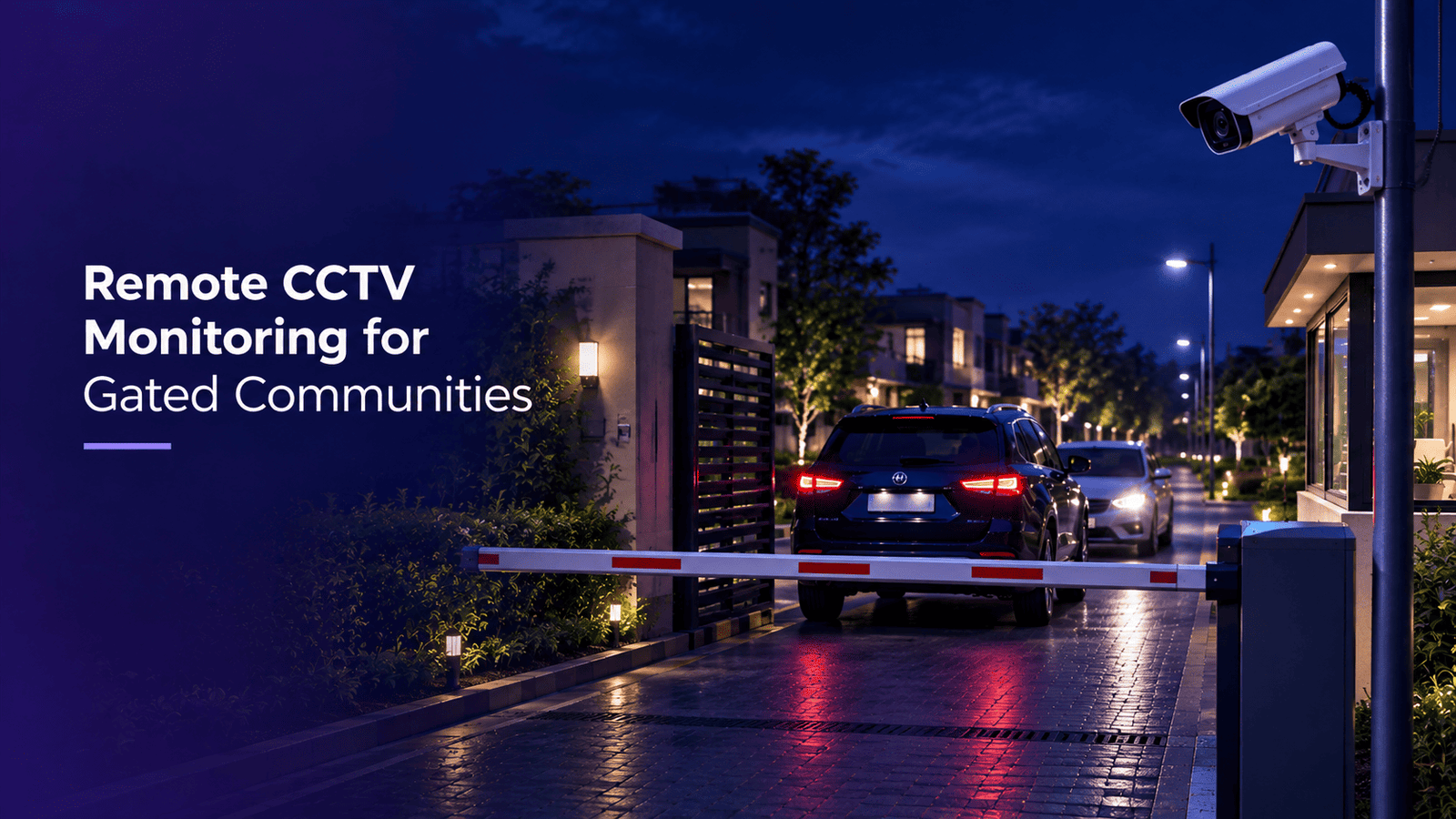
Remote CCTV Monitoring for Gated Communities Starts at the Gate
TLDR Remote CCTV monitoring for gated communities puts a trained operator behind your gate cameras instead of leaving them to record unwatched. The gate stops vehicles without codes. It does not stop the car that follows a resident through, the visitor who talks their way in, or the person who walks around the barrier entirely. Live monitoring covers what the barrier cannot.
A resident badges through the gate at 11 p.m. A second car follows two lengths behind, close enough to clear the arm before it drops.
The gate did its job. The camera recorded the plate. Nobody looked at either until a resident reported a stolen catalytic converter three days later.
That sequence repeats across gated communities everywhere. The barrier controls vehicles with valid credentials and does nothing about the ones without them. Remote CCTV monitoring for gated communities closes that gap by putting a person behind the camera while the gate is still open.
What Remote CCTV Monitoring for Gated Communities Covers
Remote CCTV monitoring for gated communities connects your existing cameras to an off-site monitoring center staffed by trained operators. They watch the feeds live, verify what they see, and act on a protocol your board defines.
The coverage priority runs in a specific order. Entry and exit gates come first because that is where controlled access either works or fails. Visitor parking and resident parking decks come next, followed by the clubhouse, pool, mailroom, and perimeter fencing.
Every one of those is common property under association control, which makes it appropriate for surveillance. Private patios, unit windows, and interiors are not, and the difference matters legally as much as practically.
Why the Gate Alone Does Not Secure the Community
A gated community uses controlled entry to restrict who reaches the interior. The barrier works against casual entry. It does not work against four common scenarios.
Tailgating. A vehicle follows an authorized car through before the arm drops. No code entered, no record created, no alert raised.
Talking through. A visitor convinces a resident at the callbox to buzz them in, or catches a resident holding the pedestrian gate.
Perimeter walk-in. Someone skips the gate entirely and enters on foot through a fence gap, a service entrance, or an unsecured side path.
Credential misuse. A former resident, contractor, or household employee still holds a working code or fob nobody revoked.
None of these trigger an alarm. All four are visible on camera as they happen, and all four are invisible until someone reviews footage days later.
The Virtual Gate Guard Model
A virtual gate guard is a trained operator watching your entry point remotely, verifying arrivals through camera and intercom before access is granted.
The sequence works the same way a booth guard’s would. A visitor arrives, presses the callbox, and the operator sees them on camera, asks who they are visiting, checks the resident directory, and either grants access or holds them at the gate.
The difference is coverage. A booth guard covers the hours they are scheduled. The virtual security guard model covers every hour without gaps at shift change, meal breaks, or callouts. Our remote guarding services apply the same protocol at 3 a.m. as at 3 p.m.
License Plate Recognition at the Entry Point
License plate recognition cameras read and log the plate of every vehicle entering and exiting. Paired with remote monitoring, that log becomes something an operator can act on rather than a database nobody queries.
A resident vehicle enters and matches the registry. A visitor vehicle enters and gets flagged for verification. A vehicle that appeared three nights in a row without a matching resident gets escalated to management before anything happens.
The value sits in the pairing. LPR alone builds a record. LPR watched by an operator turns that record into a live alert while the vehicle is still on the property.
Visitor and Vehicle Verification
Verification is where remote monitoring separates from a callbox and a camera. An operator sees the person, hears them, checks the directory, and confirms with the resident before releasing the gate.
That process catches problems a resident buzzing blindly from an apartment cannot. The delivery driver with no visible vehicle marking. The contractor arriving outside scheduled hours. The visitor who names a resident who moved out last year.
Communities that also manage package delivery and contractor access can extend the same coverage through virtual doorman services, so entry verification and delivery logging run under one protocol.
Active Deterrence Through Two-Way Audio
Watching an incident develop is only half the value. Interrupting it is the other half.
Two-way audio lets an operator speak directly through on-site speakers. Someone testing car doors in the parking deck hears a live voice telling them they are being watched and recorded, with their description read back to them.
That intervention ends most incidents before police involvement is needed. It is also the clearest demonstration to residents that the cameras are doing something, since live security monitoring produces a visible response instead of a report filed after the loss.
Response Time at the Gate
Speed decides outcomes at an entry point because the window is short. A tailgating vehicle is inside the community within seconds.
An operator watching the gate feed sees the second vehicle enter, notes the plate, and escalates immediately. Depending on the protocol, that means an audio challenge, a call to management, or a police contact with a plate number already recorded.
The same event under recording-only coverage produces nothing until someone reviews the footage. Response time is the difference between a logged plate and a documented loss.
Comparing Remote Monitoring With On-Site Guards
A gate booth guard provides physical presence and handles situations that need someone standing there. That value is real.
The limits are staffing and cost. Covering a gate 24 hours a day takes four to five full-time guards once shifts, holidays, and coverage for absences are included. Most associations fund one shift and leave the remaining hours to the barrier alone.
Remote monitoring covers all hours at a fraction of that cost, and it covers more than the gate. The operator watching your entrance also watches the parking deck, the pool, and the mailroom in the same shift. The full comparison between monitoring and guards breaks down the numbers.
Many communities run both: a guard during peak hours for presence, remote monitoring for the overnight and weekend hours the guard does not cover.
Legal Boundaries for HOA Camera Monitoring
Camera decisions carry legal weight because the board acts on behalf of every resident.
Legal analysis of security cameras in HOA common areas points to a consistent standard: surveillance is generally permitted where residents have no reasonable expectation of privacy, and prohibited where they do. A gate qualifies. A camera angle that captures a ground-floor window does not.
Guidance on HOA camera rights and privacy limits treats camera angle as part of compliance, not just camera placement. Audio recording carries separate rules that vary by state, and consent requirements apply differently than they do for video.
Broader considerations for community associations using cameras also flag access control as a primary exposure point. Limit footage viewing to a named list, log every access, and revoke credentials the day someone leaves their role.
Signage and Resident Notice
Residents and visitors should know surveillance is active before they enter. Most communities handle this with signage at the gate and a written notice in the resident handbook.
Signage does double duty. It meets transparency expectations that many jurisdictions require, and it strengthens deterrence, since closed-circuit television works partly through the knowledge that it is there.
The notice should state that cameras operate in common areas, name the association as operator, and point residents to the full policy if they want the details.
How GCCTVMS Handles Remote CCTV Monitoring for Gated Communities
Our operators watch your gate and common area feeds under a protocol your board sets during onboarding. Who gets contacted first, under what circumstances, and what the operator does before that call.
That protocol is the part that matters. When an operator sees a vehicle tailgate through at 2 a.m., the sequence is already decided: verify, challenge through audio, escalate, document with timestamp. Real-time security monitoring only works when the response is written before it is needed.
We provide residential surveillance and community monitoring across the USA, UK, Singapore, and Pakistan. Live monitoring costs $0.20 per camera per hour, and alert monitoring costs $0.10 per camera per hour. These prices may vary from time to time and are subject to inflation and rising costs.
If your board wants to see how this would work at your entrance, schedule a demo and we will review your gate layout and recommend the coverage and escalation path to match.
Key Takeaways
- Remote CCTV monitoring for gated communities covers what the barrier cannot: tailgating, talk-through entry, perimeter walk-ins, and unrevoked credentials.
- A virtual gate guard verifies arrivals through camera and intercom every hour, without the shift gaps a booth guard creates.
- License plate recognition builds a record. Paired with a live operator, it becomes an alert while the vehicle is still on the property.
- Two-way audio lets operators interrupt incidents in progress rather than documenting them afterward.
- HOA camera monitoring must avoid private residences, use clear signage, and restrict footage access to a named, logged list.
FAQs
How does remote CCTV monitoring work for gated communities?
Cameras at gates, parking areas, and common spaces stream live footage to an off-site monitoring center where operators watch in real time and respond to incidents.
Are gated communities with remote monitoring safer than those without it?
Active monitoring adds real-time response on top of the physical gate, addressing threats that a barrier alone cannot stop, such as tailgating or after-hours trespassing.
Can remote monitoring replace an on-site security guard?
It can reduce dependence on 24/7 physical staffing by covering entrances and common areas continuously, often at lower cost than full-time guards.
What areas of a gated community benefit most from remote monitoring?
Entry and exit gates, parking structures, pools, and clubhouses are typically prioritized since they see the highest foot traffic and risk.
Does remote monitoring help with visitor and vehicle verification?
Yes, operators can visually verify visitors and match vehicles against records before granting access, reducing unauthorized entry.
What legal considerations apply to gated community camera monitoring?
Communities must avoid filming private residences, provide clear signage, and follow state laws on privacy and audio recording consent.
How quickly can remote monitoring respond to an incident at a gate?
Trained operators can identify and address suspicious activity within seconds, often using two-way audio to intervene before an incident escalates.
