




CCTV Monitoring Services Explained: Coverage, Response, and Pricing
TLDR CCTV monitoring services put trained operators behind your existing cameras so incidents get a response while they are happening. Coverage spans live watching, two-way audio intervention, police dispatch, and documented incident reports. Pricing runs per camera per hour, which means cost scales with camera count and coverage hours rather than a flat monthly guess.
Most businesses already own cameras. Very few have anyone watching them.
That gap is what CCTV monitoring services fill. The cameras stay where they are. What changes is whether a trained person sees the break-in at 2 a.m. or whether the footage sits on a drive until someone checks it the next morning.
This guide covers what the service includes, how operators respond, which businesses benefit most, what privacy rules apply, and what it costs.
What CCTV Monitoring Services Actually Include
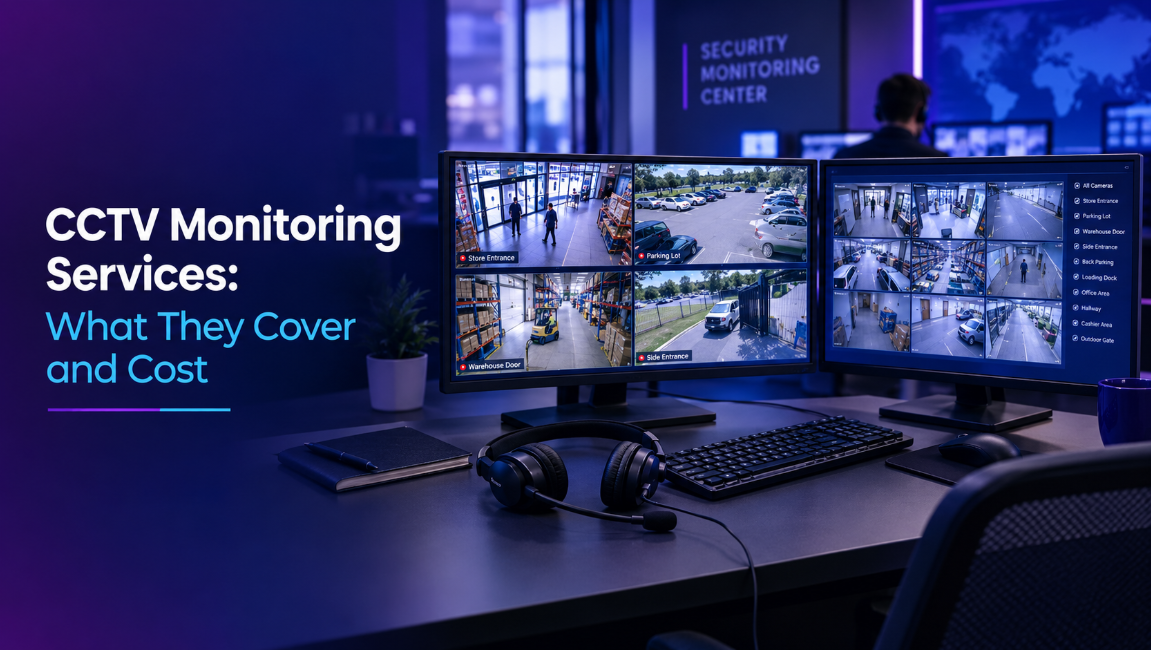
CCTV monitoring services connect your on-site cameras to a remote monitoring center where operators watch the feeds in real time.
Closed-circuit television as a technology has always supported both recording and live viewing. The difference in practice is whether anyone is assigned to watch. A recorded-only setup documents events. A monitored setup interrupts them.
A complete service covers five functions: live feed watching, threat verification, active intervention through audio, escalation to police or site contacts, and written incident documentation with timestamps.
How CCTV Monitoring Works Step by Step
The sequence runs the same way every time, which is what makes response times predictable.
An operator watching a feed spots activity that does not belong. They verify what they are seeing rather than reacting to motion alone, checking whether the person is staff, a scheduled delivery, or an intruder.
Once verified, the operator acts on the protocol set during onboarding. That usually means an audio warning first, then a police call, then a notification to the site contact, with every step logged. Understanding how CCTV systems operate at the hardware level helps, but the response protocol is what turns hardware into a service.
Live Monitoring Versus Alert-Based Monitoring
Two models exist, and they suit different sites and budgets.
Live monitoring means operators watch your feeds continuously during agreed hours. Suited to high-risk sites, after-hours coverage, and properties where an incident needs interruption rather than documentation.
Alert-based monitoring means the system flags events through analytics or sensors, and an operator reviews the flagged clip and responds. Lower cost, slightly slower, and appropriate for lower-risk sites or daytime coverage where staff are present.
Many businesses run both: live monitoring overnight and on weekends, alert-based during staffed hours.
What Operators Do When They Spot a Threat
The intervention tools matter more than the camera specification.
Two-way audio lets an operator speak directly through on-site speakers. Someone testing door handles hears a live voice describing them and confirming they are being recorded. That alone ends most incidents.
Verified police dispatch carries more weight than an unverified alarm. An operator who watched the breach happen gives police a confirmed event rather than a sensor trigger, which affects response priority.
Site contact notification reaches the owner or manager with context, not just an alert. The 60-second response window is where an incident either stops or completes.
Working With Cameras You Already Own
Most businesses do not need new hardware to start monitoring.
Modern IP cameras connect directly to a remote monitoring platform. Older analog systems usually need an encoder or a compatible recorder, which is a smaller upgrade than replacing every camera.
What matters more than camera age is coverage and image quality. A camera pointed at the wrong area or producing unusable night footage limits what any operator can do. The problems that undermine monitoring services usually trace back to setup rather than the monitoring itself.
Which Businesses Benefit Most
The highest value shows up where exposure is high and staffing is thin.
- Retail stores facing shrinkage during trading hours and break-ins after close
- Warehouses with valuable inventory, loading docks, and long unstaffed stretches
- Construction sites holding equipment and materials in open, poorly lit areas
- Parking lots and structures where vehicle crime and liability claims concentrate
- Healthcare facilities balancing access needs against controlled-substance security
- Multi-site operators who cannot staff every location but need coverage at all of them
Broader physical security trends point the same direction: organizations are shifting budget from static presence toward monitored, response-capable systems.
Privacy and Compliance Requirements
Monitoring brings legal obligations that recording alone also carries, though monitoring raises the stakes because more people view the footage.
The ICO’s guidance on video surveillance sets out the core requirements for UK operations: a clear purpose for the system, visible signage informing people they are recorded, restricted access to footage, secure storage, and retention limited to what the purpose requires.
Similar principles apply across most jurisdictions even where the specific law differs. Academic coverage of CCTV surveillance practice notes the same tension everywhere: surveillance value rises with coverage, and privacy obligations rise with it.
Practical compliance means three things. Post signage at entry points. Keep a named list of who can view footage and log every access. Set retention to the shortest period that still serves your purpose.
CCTV Monitoring Services Versus Security Guards
A guard provides physical presence and handles situations cameras cannot, such as escorting someone off the property or responding to a medical incident on site.
The limits are coverage and cost. One guard covers one location during one shift. Covering a site 24 hours a day takes four to five full-time guards once shifts, holidays, and absence cover are included.
Monitoring covers every camera on the property during every contracted hour, at a fraction of that cost. The full cost comparison breaks down the numbers, and many sites run both: a guard during peak hours, monitoring for the rest.
What CCTV Monitoring Services Cost
Pricing works per camera per hour, which makes the total predictable once you know your camera count and coverage window.
GCCTVMS charges $0.20 per camera per hour for live monitoring and $0.10 per camera per hour for alert and alarm monitoring. A four-camera site monitored around the clock runs $576 per month on live monitoring, or $288 per month on alert-based. These prices may vary from time to time and are subject to inflation and rising costs.
Three factors move the number: camera count, coverage hours, and monitoring type. A site that only needs overnight coverage pays for those hours rather than a full day. A site with eight cameras pays double a site with four.
Compare that against the loss it prevents. A single break-in commonly costs more than a year of monitoring, which is the calculation most businesses skip until after the first incident.
Choosing a Provider
Ask three questions before signing anything.
Who is watching, and when? Some providers run automated alerts with minimal human review. Ask for staffing detail during your specific coverage hours, not general claims.
What is the response protocol? A provider should be able to describe exactly what happens in the first 60 seconds of a verified threat, in writing, before you sign.
What happens when a camera goes offline? System health monitoring separates a service from a subscription. A provider tracking uptime catches the failure before it becomes a coverage gap.
Our outsourced CCTV monitoring and professional monitoring services pages cover how we answer each of those.
How GCCTVMS Delivers CCTV Monitoring Services
Our operators watch your feeds under a protocol your business defines during onboarding: who gets contacted first, under what circumstances, and what the operator does before that call happens.
We provide 24/7 live CCTV monitoring across the USA, UK, Singapore, and Pakistan, covering retail, warehousing, construction, healthcare, parking, and multi-site operations. Every incident produces a timestamped report you can hand to police or an insurer.
If you want the full breakdown of coverage models and service scope, our main CCTV monitoring services page goes deeper on what each tier includes.
Book 30 Minutes Free Call and we will review your camera setup, coverage gaps, and the escalation path we would recommend.
Key Takeaways
- CCTV monitoring services add live watching, threat verification, audio intervention, police escalation, and documented reporting on top of cameras you already own.
- Live monitoring suits high-risk and after-hours coverage. Alert-based monitoring suits lower-risk sites and staffed hours at lower cost.
- Most existing IP cameras connect without replacement. Analog systems typically need an encoder rather than new cameras.
- Compliance requires signage, restricted footage access, secure storage, and retention limited to purpose, per ICO guidance and equivalent rules elsewhere.
- Pricing runs per camera per hour, so cost scales with camera count and coverage hours rather than a flat monthly estimate.
FAQs
What are CCTV monitoring services?
CCTV monitoring services connect your cameras to a remote monitoring center where trained operators watch live feeds and respond to suspicious activity in real time, instead of only recording footage for later review.
How is CCTV monitoring different from a standard security camera system?
A standard system records events for review after they happen. Monitoring adds a person who actively watches, verifies threats, and acts on them while the incident is still unfolding.
What can a monitoring operator do when they spot a threat?
Operators can speak through camera speakers using two-way audio, contact police or emergency services, and alert site owners or on-site staff within seconds.
Can CCTV monitoring services work with cameras I already own?
In most cases yes. Modern IP cameras connect to a remote monitoring platform, while older analog systems may need an encoder or recorder upgrade.
What types of businesses benefit most from CCTV monitoring?
Retail stores, warehouses, construction sites, parking lots, healthcare facilities, and multi-site operations gain the most, since these places face after-hours theft, vandalism, and limited staffing.
What factors affect the cost of CCTV monitoring services?
Pricing depends mainly on the number of cameras, the hours of coverage, the type of monitoring (live or alert-based), and any extra services such as audio intervention or reporting.
Are there privacy rules businesses must follow when using CCTV monitoring?
Yes. Businesses should use clear signage, limit who can view footage, store recordings securely, and keep them only as long as needed, following local laws such as UK GDPR guidance from the ICO.
Can CCTV monitoring replace on-site security guards?
It can reduce reliance on full-time guards by covering entrances and open areas remotely, though some sites still keep a physical presence for tasks cameras cannot handle.
