




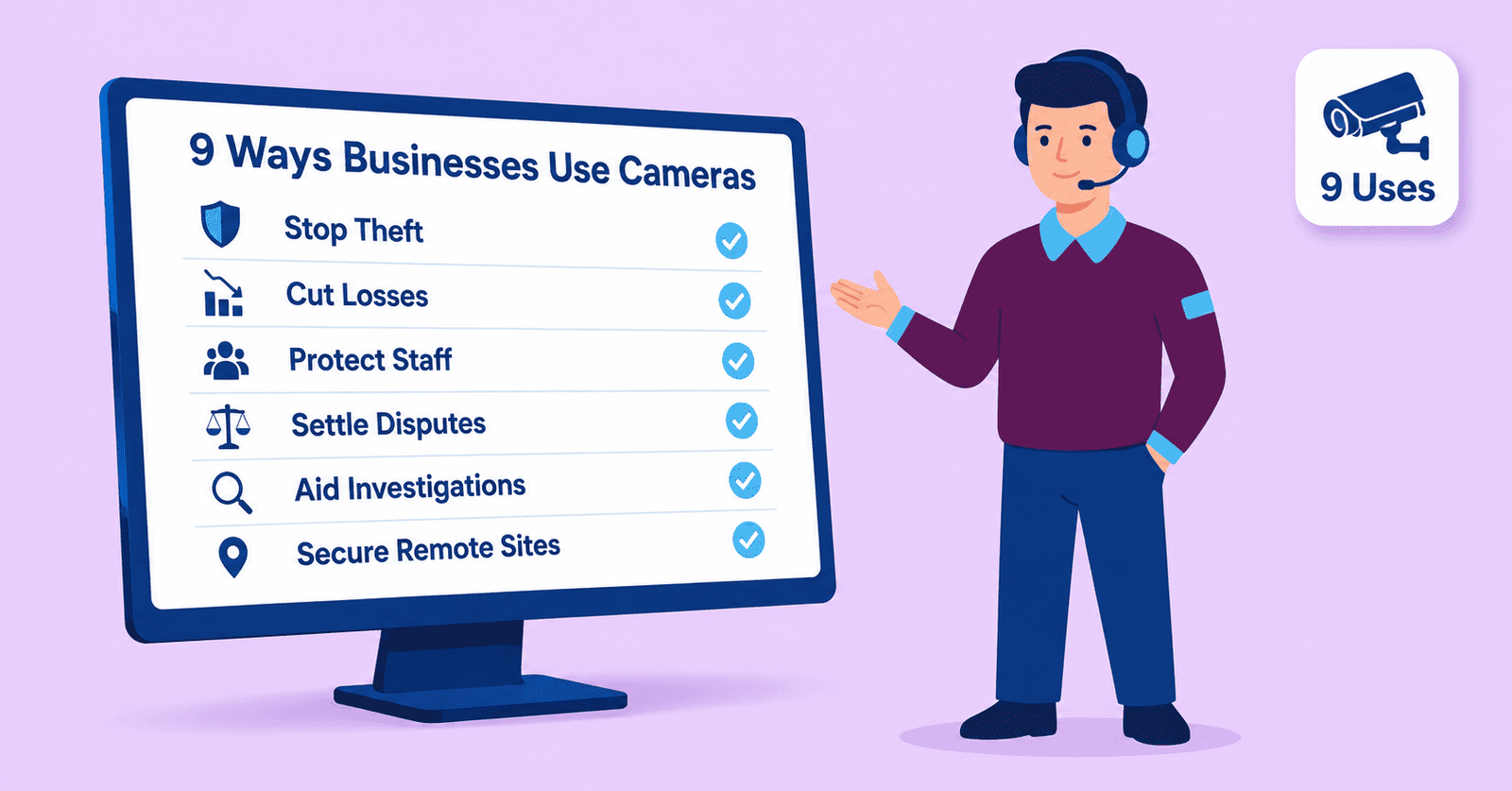
Surveillance Cameras in Business Do More Than Watch for Theft
A Colorado retailer once paid out $15 million on a single slip-and-fall claim. The store had cameras. The footage did not have enough detail to support the business’s side of the story, and the case went against them.
That is the risk of treating surveillance cameras as a single-purpose tool. Most owners think of cameras as a theft deterrent and stop there. In practice, the same equipment supports at least nine distinct business functions, and missing out on the other eight leaves real value on the table.
Quick Summary
Surveillance cameras in business go far beyond catching shoplifters. They cut retail losses, protect staff, settle disputes, connect to sales data, help police solve crimes, reveal customer behavior, secure remote sites, and tie every security tool into one system. Each benefit depends on how the cameras are used, not just whether they are installed.
1. Stopping Theft Before It Happens
Visible cameras discourage opportunistic theft because most people avoid acting where they know they are being watched. This is the use case every business owner already expects.
The deterrent works best when cameras are placed where people can see them and where a response feels likely. A camera in a back office nobody checks does not carry the same weight as one an employee knows is actively monitored.
2. Cutting Store Losses
Beyond deterrence, surveillance cameras directly reduce shrinkage when paired with the right resolution and analytics. One major UK retailer combined high-resolution cameras, video management software, and analytics to cut shrinkage from 0.81% to 0.44% within two years, saving hundreds of thousands of pounds and increasing the number of employees caught in the act fivefold.
The lesson is not just “install cameras.” It is that resolution and follow-through determine whether footage actually identifies who took what.
3. Watching Over Employees and Safety
Cameras in common areas let businesses monitor safety compliance and worker conduct without stepping into private spaces like restrooms or locker rooms. The legal boundary is well established: employers can photograph staff in plain view during working hours, but the camera must stay visible, not hidden.
One US manufacturing plant documented a 20% productivity increase after adding higher-resolution surveillance to its shop floor and warehouse, which let supervisors intervene earlier and reduce accidents. The same footage also verified worker hours and supported safety compliance reviews.
4. Settling Disputes and Claims
A customer claims an injury. An employee disputes a write-up. A delivery driver says a package arrived damaged. Clear footage resolves these faster than conflicting accounts ever could.
The standard for usable footage is higher than most owners assume. Courts have dismissed cases where surveillance was the primary evidence but lacked sufficient image detail to support the claim. A business with cameras installed also signals an intent to protect visitors, which carries its own liability weight if that intent is not backed by usable footage.
5. Linking Cameras to Sales Records
Video management systems can connect directly to point-of-sale terminals. Instead of reviewing hours of footage, a manager clicks a line item in a sales report and the system jumps straight to the video of that exact transaction.
As one security industry executive explained, the value comes from combining two ordinary data points, the sale and the footage, into one lookup. This turns a slow manual review into a search that takes seconds, and it catches register-level issues that a POS log alone would never reveal.
6. Helping Police Solve Crimes
Surveillance footage supports law enforcement well beyond the property it covers. A major US transit authority used its bus camera network to help police catch a bank robber who had jumped onto a train to escape. Operators matched the suspect’s description to live footage and directed the train to wait at the next station until officers arrived.
In a separate case, the same system let a monitoring center zoom in on a passenger who assaulted a driver, feeding a clear image to responding officers within a minute. Neither outcome would have been possible with recorded-only footage nobody was watching in real time.
7. Understanding Customer Behavior
Retailers use the same cameras that deter theft to study how customers move through a store. Heat mapping shows which displays draw the most attention, which supports decisions on product placement and even what vendors are charged for premium shelf space.
Combined with POS data, this turns surveillance into a business intelligence tool, not just a security one. Store layouts, queue management, and targeted promotions all draw on the same footage originally installed to watch for theft.
8. Securing Remote and Construction Sites
Construction sites and other remote locations face security challenges that urban properties do not: limited lighting, no nearby foot traffic, and long stretches with no one on-site. Large, open footprints and minimal overnight supervision make equipment theft and trespassing far easier.
One construction firm reported saving over $3,000 per month after adding remote video monitoring to its jobsites, crediting the proactive oversight for the drop in losses. Mobile, solar-powered camera units make this kind of coverage possible even where permanent power and network infrastructure do not exist yet.
9. Bringing All Security Tools Into One System
The most advanced use of surveillance cameras is not the cameras themselves. It is tying video, access control, alarms, and communication tools into a single platform. When an incident occurs, operators do not want to juggle five separate applications while trying to respond.
After a medical emergency at a major European airport, security staff used a unified system to pull up the camera feed, alert mobile officers over radio, send text notifications, and confirm that police and ambulance services had been contacted, all from one screen. That level of coordination is only possible when the systems are connected, not standalone.
Why Surveillance Cameras Need Monitoring to Deliver These Benefits
Every use case above shares one requirement: someone has to be watching, or at least reviewing, the footage for it to create value. A camera recording to a hard drive that nobody checks delivers a fraction of what the same camera delivers with active monitoring behind it.
Smart security cameras and smart cameras with built-in analytics help by pre-filtering what deserves attention. But analytics alone still hand off the decision to a person. The businesses getting the most from surveillance cameras are the ones pairing hardware with a live response, not just storage.
Key Takeaways
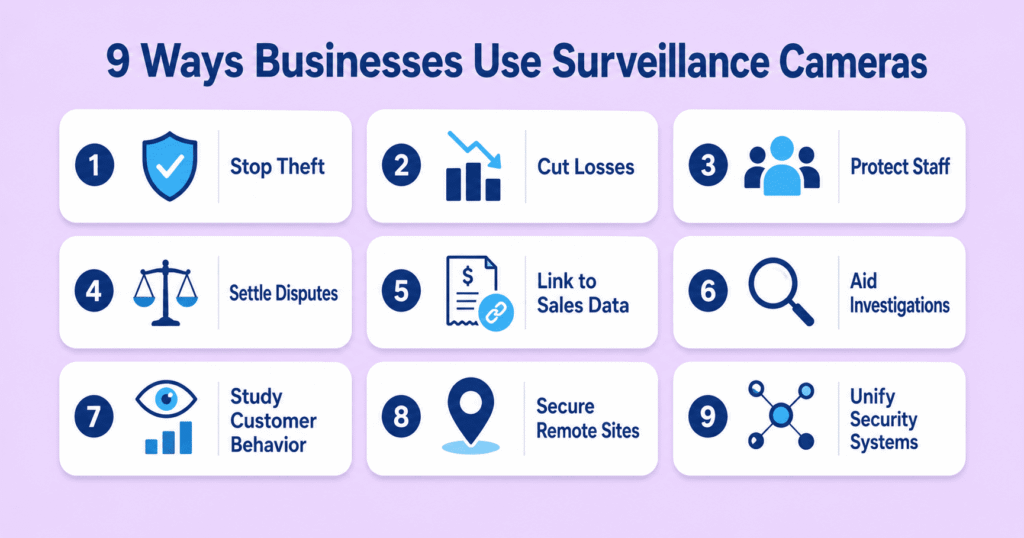
- Surveillance cameras in business support at least nine functions: theft deterrence, loss prevention, employee safety, dispute resolution, POS integration, police cooperation, customer behavior analysis, remote site security, and unified system management.
- Higher resolution and analytics turn cameras from a deterrent into a measurable loss-prevention tool, as shown by a UK retailer’s shrinkage drop from 0.81% to 0.44%.
- Courts have dismissed cases where surveillance footage lacked enough detail, making image quality a legal issue, not just a technical one.
- Remote and construction sites benefit significantly from mobile, monitored camera units, with one contractor saving over $3,000 per month.
- None of these benefits fully materialize without monitoring behind the cameras, whether from live operators or a combination of analytics and human review.
How GCCTVMS Supports Every Use Case Above
GCCTVMS provides live monitoring that turns each of these nine uses into something a business actively benefits from, not just technically owns. Trained operators watch feeds in real time, flag incidents as they happen, and document everything with a timestamp, which supports theft prevention, dispute resolution, and law enforcement cooperation all at once.
For businesses running multiple sites, including construction and remote locations, our remote monitoring services extend the same live coverage without requiring permanent on-site staff. Live monitoring costs $0.20 per camera per hour, and alert monitoring costs $0.10 per camera per hour.
We work with retail stores, warehouses, offices, and construction sites across the USA, UK, Singapore, and Pakistan, connecting cameras, POS systems, and access control into coverage that supports every function covered in this article, not just theft deterrence.
Get a free call, and we will review how your current cameras could support more than security alone.
FAQs
What are the main uses of surveillance cameras in business?
Businesses use surveillance cameras to deter theft, reduce shrinkage, monitor workplace safety, resolve disputes, assist police investigations, understand customer behavior, secure remote sites, and connect footage to sales records. Live monitoring adds a person who acts on what the cameras see.
What are the main uses of surveillance cameras in business?
Businesses use surveillance cameras to deter theft, reduce shrinkage, monitor workplace safety, resolve disputes, assist police investigations, understand customer behavior, secure remote sites, and connect footage to sales records. Live monitoring adds a person who acts on what the cameras see.
Do surveillance cameras actually reduce theft?
Yes, when placed and used correctly. One UK retailer cut shrinkage from 0.81% to 0.44% within two years by combining high-resolution cameras with video analytics, catching five times more employees in the act.
Can surveillance cameras help with legal disputes?
Yes. Clear, timestamped footage settles slip-and-fall claims, workplace disputes, and customer complaints quickly. Courts have dismissed cases where video evidence lacked sufficient detail, which is why image quality matters as much as camera count.
How do surveillance cameras connect to point-of-sale systems?
Video management software links directly to POS terminals. A manager can click a line item in a sales report and jump straight to the footage of that transaction, without scrubbing through hours of video.
Are smart surveillance cameras different from regular cameras?
Smart security cameras add analytics, such as motion classification, heat mapping, or automated alerts, on top of standard recording. The camera hardware often looks similar. The difference is in what the system can process and flag automatically.
