




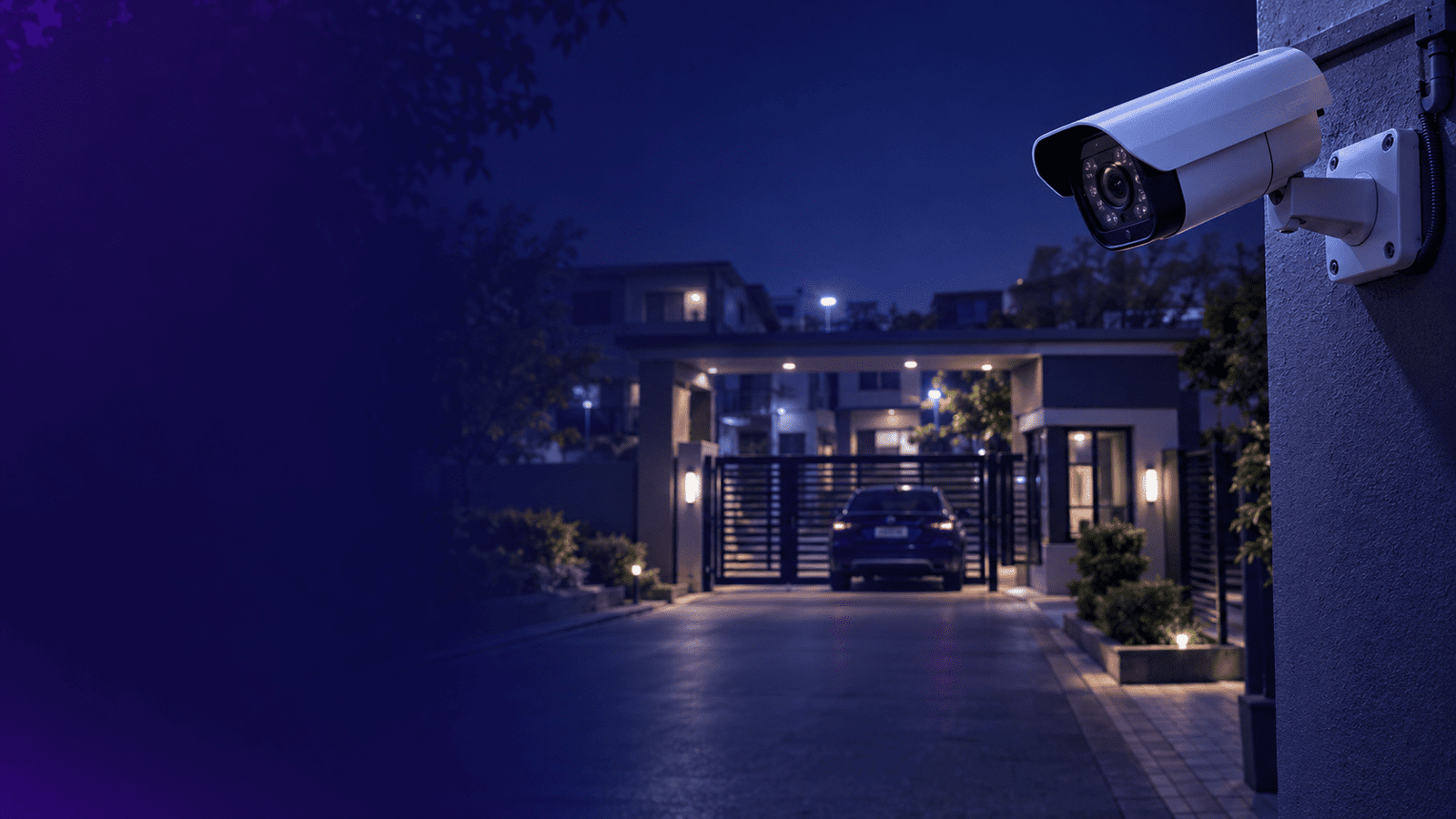
What Boards Need to Get Right About CCTV Monitoring for Residential Societies
TLDR
CCTV monitoring for residential societies works when three things line up: cameras cover the right common areas, a written policy governs who sees the footage, and someone watches the feeds in real time. Most communities get the cameras right and skip the other two, which turns a security investment into a liability.
A gated community installs sixteen cameras at the entrance, the clubhouse, and both parking decks. Six months later a resident’s car gets broken into at 2 a.m.
The board pulls the footage. It exists, and it is clear. But nobody saw it happen, the recording sat unreviewed for eleven hours, and the resident wants to know why the community pays for cameras that did nothing.
That gap sits at the center of CCTV monitoring for residential societies. Cameras handle the recording. Policy handles the legal exposure. Live monitoring handles the part residents actually expect: someone noticing while it happens.
What Residential Society CCTV Monitoring Covers
CCTV monitoring for residential societies means placing cameras across shared community spaces and connecting them to a system that either records for later review or feeds a live monitoring center.
The common areas that matter most in a gated community or apartment complex are the entry and exit gates, visitor parking, resident parking decks, lobbies and hallways, clubhouse and pool areas, mail and package rooms, and perimeter fencing.
Every one of those is shared property under the association’s control, which is what makes them appropriate for surveillance. Private balconies, unit windows, and interiors are not, and treating them the same way creates legal problems covered further down.
The Legal Boundaries Boards Cannot Ignore
Community associations operate under a different set of rules than private businesses. The board acts on behalf of residents, which means camera decisions carry legal weight for everyone in the community.
Legal analysis of security cameras in HOA common areas points to the same core principle across jurisdictions: surveillance is generally permitted in areas where residents have no reasonable expectation of privacy, and prohibited where they do. A lobby qualifies. A window into someone’s living room does not.
The distinction gets harder in edge cases. A camera aimed at a parking deck that also captures a ground-floor patio creates exposure even when the intent was legitimate. Legal guidance on HOA security camera rights and privacy limits treats camera angle as part of the compliance question, not just camera location.
Building a Written Community CCTV Policy
A written policy protects the association more than the cameras do. It defines what the system covers, who can access footage, how long recordings are kept, and what happens when a resident requests a clip.
Practical guidance on building an HOA security camera policy points to a few elements that belong in every version: the purpose of the system, the areas under surveillance, who holds access rights, retention duration, the request procedure for residents, and the notice requirements.
Boards that skip this step usually discover the gap during a dispute. A resident asks for footage of an incident, two board members disagree about whether to release it, and the association has no written standard to point to.
Notification and Signage Requirements
Residents and visitors should know surveillance is active before they enter the space. Most communities handle this with signage at entry points and a written notice distributed to residents.
Signage serves two purposes at once. It satisfies transparency expectations that many jurisdictions require, and it strengthens the deterrent effect. A visible sign at a gate does more preventive work than a hidden camera nobody knows about.
The notice should state that cameras operate in common areas, name the association as the operator, and point residents toward the full policy document if they want details.
Access Control for Footage
Deciding who can view recordings matters as much as deciding where cameras point. Unrestricted access turns a security system into a privacy risk.
Considerations for community associations using security cameras consistently flag access control as a primary exposure point. A board member reviewing footage out of curiosity, or a maintenance staffer with login credentials nobody revoked, creates liability the association carries.
Restrict viewing to a named list: the security provider, one or two designated board members, and property management. Log every access event. Revoke credentials the day someone leaves their role, not weeks later.
Retention Periods and Storage
Footage should be kept long enough to serve its purpose and no longer. Most residential societies land somewhere between fifteen and thirty days, though local law and insurance requirements can push that either direction.
The right window depends on how quickly incidents surface in your community. A package theft gets reported the same day. Vandalism in a rarely used stairwell might go unnoticed for a week.
Storage location matters alongside duration. Local recorders in a management office are vulnerable to the same break-in they were meant to document. Cloud-backed storage keeps footage available even when on-site equipment is stolen or damaged. The cloud versus local storage decision affects both retention capacity and evidence survival.
Recording Versus Live Monitoring
Here is where most communities lose the value they paid for. A recording system documents incidents. A monitored system interrupts them.
Closed-circuit television as a technology has always been capable of both. The difference is whether a person watches the feed while events unfold, or whether the footage sits on a drive until someone has a reason to look.
For a residential society, that distinction shows up in the incidents residents care about: a stranger following someone through the gate, a package taken from the mailroom, a car circling the visitor lot at 3 a.m. All three are visible in real time. All three are invisible until morning if nobody is watching. Understanding what real-time CCTV monitoring involves helps boards evaluate what they are actually buying.
Where Live Monitoring Changes Outcomes
Consider the same package theft under two systems. Under a recording-only setup, the resident reports it, management pulls footage the next day, and the association files a report that goes nowhere.
Under live monitoring, an operator sees an unfamiliar person entering the mailroom, watches them take a package that does not match their unit, and alerts management or police while the person is still on the property.
The camera is identical. The response time is what separates a documented loss from a prevented one, and it is the single factor residents notice most.
Entry Gate and Visitor Management
Gated communities carry a specific vulnerability at the entrance. Tailgating, where an unauthorized vehicle follows a resident through an open gate, defeats access control entirely and leaves no record of who entered.
Live monitoring at the gate catches this as it happens. An operator watching the entry feed sees the second vehicle, notes the plate, and flags it before that car reaches the interior of the community.
For societies that also manage visitor entry, virtual doorman services extend the same coverage to intercom calls, deliveries, and contractor access, so nobody enters without verification.
Common Mistakes Residential Societies Make
A few patterns show up repeatedly across communities that installed cameras and then found the system did not perform.
- Cameras aimed at private spaces, which creates legal exposure and resident complaints
- No written policy, leaving footage access decisions to whoever asks first
- No signage, which weakens both deterrence and legal standing
- Retention set too short, so footage disappears before an incident is reported
- Nobody watching the feeds, which reduces the entire system to after-the-fact documentation
- Access credentials never revoked when board members or staff change roles
Each one is straightforward to fix during a policy review. None of them get fixed without one. The broader set of security mistakes that leave properties exposed applies to residential communities as much as to commercial sites.
How GCCTVMS Handles CCTV Monitoring for Residential Societies
Our operators watch community feeds in real time, following a response protocol your board defines during onboarding. Who gets called first, under what circumstances, and what the operator does before that call happens.
That protocol matters more than any feature list. When an operator sees someone testing car doors in the parking deck at 2 a.m., the sequence is already written: verify, alert, escalate, document. Live security monitoring only works when the response is decided in advance.
We provide residential surveillance and apartment complex monitoring across the USA, UK, Singapore, and Pakistan. Live monitoring costs $0.20 per camera per hour, and alert monitoring costs $0.10 per camera per hour. These prices may vary from time to time and are subject to inflation and rising costs.
If your board wants to see how monitored coverage would work at your property, schedule a demo and we will walk through the camera positions and escalation path we would recommend.
Key Takeaways
- CCTV monitoring for residential societies covers shared spaces only: gates, parking, lobbies, hallways, mailrooms, and perimeters, never private unit interiors or windows.
- A written community CCTV policy defining purpose, coverage, access rights, retention, and request procedures protects the association more than the hardware does.
- Signage at entry points satisfies transparency expectations and strengthens deterrence at the same time.
- Footage access should be limited to a named list with logged access events and credentials revoked immediately on role change.
- Recording documents incidents after they happen. Live monitoring interrupts them while they happen, which is the outcome residents actually expect.
FAQs
Do residential societies need special permission to install CCTV cameras?
Most societies can install cameras in common areas under their governing bylaws, but placement must respect resident privacy and often requires board approval.
Where should cameras not be placed in a residential society?
Cameras should avoid private windows, restrooms, and individual unit interiors, focusing only on shared spaces like gates, parking, and hallways.
What is the benefit of remote CCTV monitoring over recording-only systems?
Remote monitoring allows live operators to detect and respond to incidents in real time, rather than relying on footage that is reviewed after an incident occurs.
Are residents required to be notified about CCTV surveillance?
Yes, most societies post visible signage and share a written policy so residents and guests know surveillance is active.
Can CCTV monitoring reduce crime in residential societies?
Visible, actively monitored cameras act as a strong deterrent and support faster response when incidents do occur.
How long should residential societies retain CCTV footage?
Retention periods vary by policy and local law, but footage is typically kept only as long as necessary for security or legal purposes.
