




Why Is CCTV Monitoring Quality So Bad?
Poor CCTV monitoring quality rarely traces back to a single fault. Most sites have several small issues stacking up at once.
The usual causes:
- Low resolution or aging cameras. Older analog and early IP units cannot resolve faces at distance regardless of settings.
- Heavy compression and storage limits. Recorders often cut bitrate to stretch retention, stripping detail from motion.
- Poor lighting, glare and infrared problems. Backlit entrances and uneven IR produce silhouettes and washed-out patches.
- Wide-angle placement. One camera covering a large area spreads pixels thin across the scene.
- Digital zoom instead of optical. Digital zoom enlarges pixels without adding detail, so the image softens.
- Dirty lenses, weather damage and old firmware. Dust, insects, condensation and outdated firmware degrade output quietly.
- Weak network and long cable runs. These cause dropped frames, stutter and reduced stream quality.
Solink’s breakdown of why CCTV quality disappoints covers similar ground across camera, network and configuration faults. Our own guide to fixing common CCTV surveillance problems walks through the diagnostic order.
Why Image Quality Matters More in Live Monitoring
A recorded clip gets reviewed later, with time to pause and enhance. A live operator gets one pass and has to decide what they are looking at.
That decision depends on pixel density. The DORI standard, based on IEC EN 62676-4:2015, sets four levels in pixels per metre. According to Infiniti Optics’ DORI definition, Detection requires 25 PPM, Observation 62 PPM, Recognition 125 PPM, and Identification 250 PPM.
At 25 PPM an operator can confirm someone is there. At 250 PPM they can describe that person in a way that holds up later. Most sites specify cameras for coverage, then expect identification-level detail from them.
How to Increase CCTV Camera Quality
Most improvements to CCTV monitoring quality cost nothing beyond time, and they are worth trying before any purchase decision.
Work through these in order:
- Check resolution and bitrate. Confirm the recorder captures at the camera’s rated resolution, not a reduced default.
- Fix the lighting. Add white light or separate infrared units where the view is dark or backlit.
- Audit position and angle. Reposition anything mounted too high, too wide, or blocked by stock, signage or growth.
- Use optical zoom or a varifocal lens. These add real detail at distance where digital zoom cannot.
- Clean lenses and update firmware. Schedule this rather than waiting for a complaint.
- Fix network and cabling. Keep runs within spec and use Power over Ethernet where possible.
Replace a camera when it cannot meet the DORI level that area needs even after correct setup. Adjust settings when the hardware is capable but configured poorly. Low-light sites often benefit most from night vision monitoring support.
Which Companies Provide the Best Quality CCTV Cameras?
Hardware sets the ceiling on CCTV monitoring quality, though choice depends on site size, budget and compliance needs rather than a single ranking. Safe and Sound Security’s review of commercial security camera brands covers the main options.
The brands that appear most often in commercial comparisons:
- Axis Communications. Strong low-light performance and open integration. Common in enterprise and critical infrastructure.
- Avigilon (Motorola Solutions). High-resolution cameras with analytics built around large sites.
- Hanwha Vision. Broad range covering mid-market through enterprise, with good image processing.
- Verkada. Cloud-managed, which suits multi-site operators who want central administration.
- Hikvision. Feature-rich at lower cost, but not NDAA-compliant, so US federal agencies and many government-linked buyers cannot use it.
Axis and Avigilon are the usual shortlist for enterprise and critical sites. Verkada’s central management suits multi-site retail or offices, and Hanwha fits mid-market budgets without dropping to entry-level quality.
Higher-resolution cameras also capture more identifiable detail, which brings data protection duties. The UK’s ICO guidance on video surveillance covers signage, restricted access to footage and retention limited to a stated purpose. In the US these rules sit at state level, and audio recording consent varies by state.
Can AI Detection Work on a Bad Quality Camera?
AI analytics read the same pixels a human operator sees. When the source image is noisy, underexposed or low resolution, the algorithm has less signal to classify.
Two failure patterns follow. Missed detections happen when a person blends into a dark or grainy background. Wrong classifications happen when shape and colour cues are weak, so a crouching person may register as an animal.
AI cannot add detail the camera did not capture. It can filter, prioritise and reduce noise in alerting, but it works on what arrives. Matching camera specification to the analytic you intend to run matters more than the analytic itself, a point covered in our overview of how AI CCTV monitoring supports security teams.
Why Do CCTV Systems Send So Many False Alerts?
False alerts are the most visible symptom of weak CCTV monitoring quality, and they are well documented.
In a May 2021 market study of 103 England-based firms with more than 50 employees, NW Security Group reported that 93 percent of medium and large firms running video analytics were seeing excessive false alarms. Their analysis of video analytics problems found 41 percent cited lens obstructions such as dirt or insects, 39 percent cited camera location or positioning, and 29 percent cited poor lighting of the camera’s field of view.
The business cost is alert fatigue. When most alerts turn out to be nothing, response slows and genuine events get treated as routine. Narrowing detection zones, reducing default sensitivity, mounting infrared lighting away from the camera body, and adding human verification before escalation all help.
Is Your CCTV Quality Good Enough? A Quick Checklist
| Check | What good looks like |
| Resolution setting | Recorder captures at the camera’s rated resolution |
| Pixel density | Meets the DORI level that area needs |
| Lighting | No backlit silhouettes or dark patches at night |
| Lens condition | Clean, free of condensation, insects and dust |
| Camera angle | Covers the access point, not mostly sky or floor |
| Zoom type | Optical or varifocal, not digital |
| Network | Stable stream, no dropped frames or stutter |
| Alert volume | Most alerts correspond to real activity |
How GCCTVMS Monitors Sites With Existing Cameras
Our operators work with the cameras a site already has in most cases, so the change is the monitoring layer rather than a hardware replacement. Where image quality limits what can be confirmed, operators can still verify presence, use two-way audio to intervene, and escalate to police or a named site contact.
Live monitoring means operators watch feeds during agreed hours. Alert monitoring means they review footage when a detector or analytic triggers. Live monitoring costs $0.20 per camera per hour and alert monitoring costs $0.10 per camera per hour, so four cameras monitored around the clock works out at $576 per month live or $288 per month on alert. Prices are subject to change.
Every incident produces a timestamped report usable with police or insurers, and camera health monitoring flags offline units before footage is needed. We cover sites across the USA, UK, Singapore and Pakistan through our 24/7 live CCTV monitoring service. To see how it works on your own cameras, get a free trial.
Key Takeaways
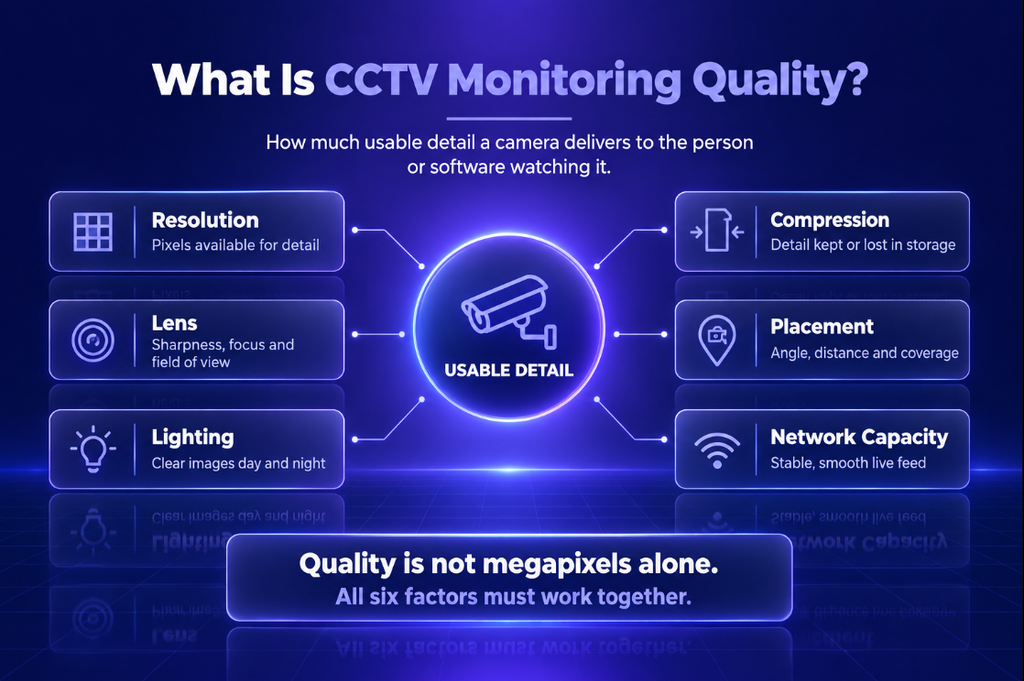
- CCTV monitoring quality depends on resolution, lens, lighting, compression, placement and network together, not megapixels alone.
- The DORI standard sets 25 PPM for detection and 250 PPM for identification, which is why cameras specified for coverage often disappoint on detail.
- Many quality problems come from configuration, so checking bitrate, lighting, angle and lens condition should come before buying new hardware.
- Analytics read the pixels the camera delivers, so AI cannot recover detail a poor image did not capture.
- NW Security Group’s 2021 England study found 93 percent of medium and large firms using video analytics reported excessive false alarms, with lens obstructions, camera positioning and poor lighting among the leading causes.
FAQs
Why is my CCTV footage blurry or pixelated?
Blur usually comes from one of four things: a dirty or damaged lens, heavy video compression, a camera set to a lower resolution than it supports, or digital zoom stretching a small part of the frame. Checking settings and cleaning the lens costs nothing and solves many cases.
How can I improve CCTV camera quality without replacing the cameras?
Raise the resolution and bitrate in the recorder settings, clean the lenses, add lighting where the view is dark, correct the camera angle, and update the firmware. Many quality complaints come from configuration rather than hardware.
Does a higher megapixel camera guarantee better CCTV quality?
No. Megapixels only help when the lens, lighting, bitrate and sensor size support them. A 4K camera on a low bitrate with a wide-angle view can produce less usable detail than a well-configured 1080p camera aimed correctly.
Which CCTV camera brands offer the best image quality?
Axis Communications, Avigilon, Hanwha Vision and Verkada appear consistently in commercial camera comparisons. Hikvision offers strong specifications at lower cost, but it is not NDAA-compliant, which rules it out of US federal and many government-linked projects.
Can AI detection work properly on low-quality CCTV cameras?
Detection accuracy drops when the source image is noisy, dark or low resolution. Analytics software reads pixels, so a camera that cannot resolve a person clearly gives the algorithm less to work with. AI cannot restore detail the camera did not capture.
Why does my CCTV system send so many false alerts?
Common triggers include insects and dirt on the lens, animals, headlights, moving foliage and sensor noise in low light. Camera position and poor lighting are frequent causes, as is detection software left on default settings.
How do I reduce false alarms on CCTV cameras?
Narrow the detection zones to exclude roads, trees and reflective surfaces, lower the sensitivity from default, mount infrared lighting away from the camera body, and have a person verify alerts before escalation.
Does poor camera quality affect remote CCTV monitoring?
Yes. An operator can only act on what the image shows. Poor detail may still let an operator confirm someone is present and respond, but it limits description, identification and evidential value.
