




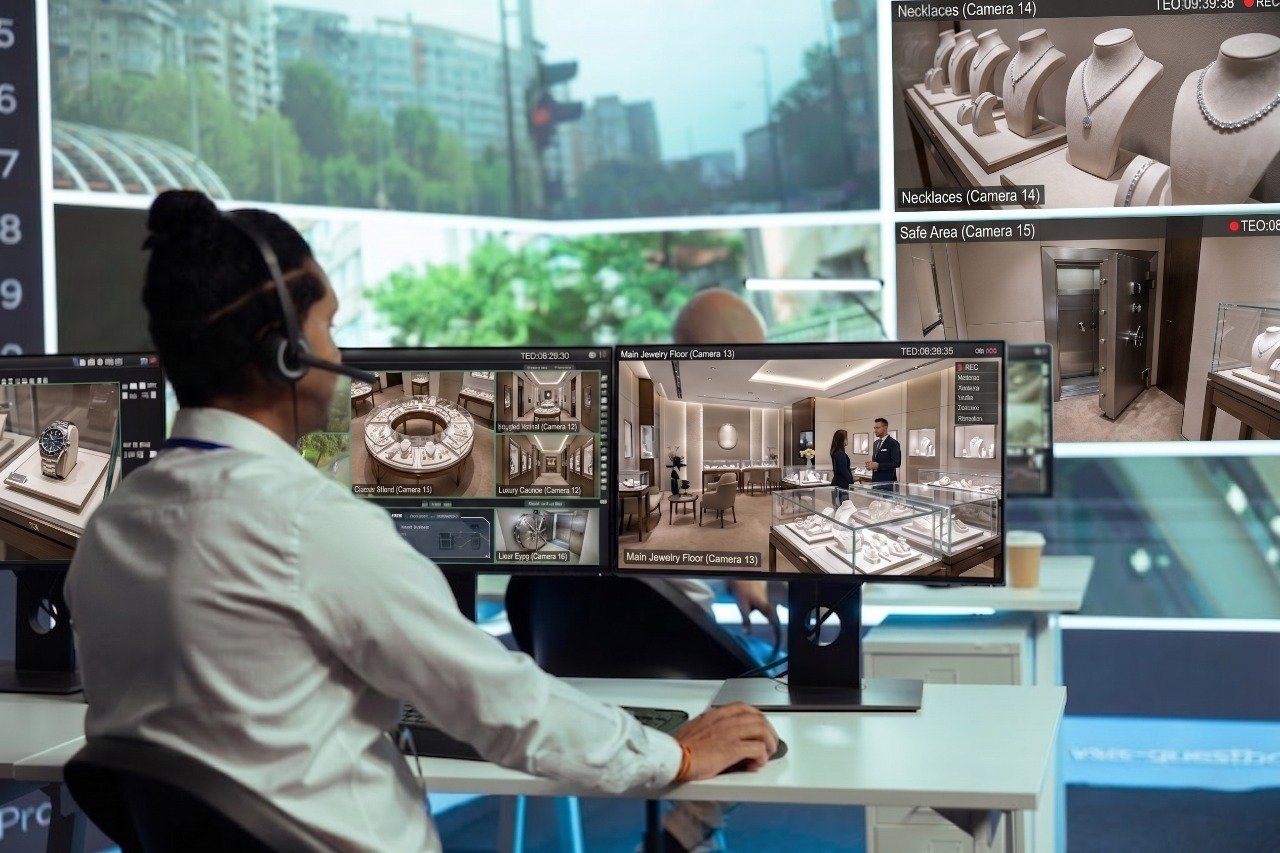
CCTV Monitoring for Jewellery Stores: Stop Smash-and-Grabs, Insider Theft, and After-Hours Break-Ins Before They Cost You
At 4:30 PM on a Tuesday in Sacramento, California, a vehicle rammed through the front entrance of a jewellery store while the owner, his family, and customers were inside. Subjects fled. An employee was critically injured. The store incurred significant damage even though no jewellery was stolen.
That’s 2026. That’s what jewellery store crime looks like now.
The Jewelers Security Alliance (JSA) reported that in 2025, incidents of vehicles being driven into stores during business hours hit 13. Pepper spray use in smash-and-grab attacks jumped from 3 incidents in 2024 to 14 in 2025. Robberies involving firearms rose from 19.6% to 23.9%. Wall-entry burglaries increased 165% between 2023 and 2024. In California alone, the JSA documented 30 violent jewellery store robberies in a single period, with the vice president of JSA stating he had never seen this level of violence in 30-plus years investigating jewellery crime.
Gold approaching $4,000 per ounce in 2025 made jewellery stores the highest-value targets in retail. A smash-and-grab crew takes 90 seconds. One million dollars in merchandise leaves in a gym bag.
GCCTVMS provides 24/7 live CCTV monitoring and camera monitoring services for jewellery stores across the USA, UK, Singapore, and Pakistan. This is the 2026 guide to CCTV monitoring for jewellery stores.
What CCTV Monitoring for Jewellery Stores Actually Means
A camera above the display case records the robbery. An operator watching that camera stops it.
Most jewellery stores have cameras. Most have recording systems that store footage on a box in the back office. The footage is reviewed after the loss. The police get a copy. The insurance claim gets filed. The inventory is gone.
That’s not CCTV monitoring for jewellery stores. That’s documentation with a 24-hour delay.
Real CCTV monitoring services for jewellery stores mean trained operators watch live feeds covering the sales floor, every display case, the entrance buzzer system, back office, vault, and parking lot simultaneously. They spot the smash-and-grab setup before the hammers come out. They see the inside job developing before inventory disappears. They issue audio warnings, dispatch police, and lock down access in real time.
Monitoreal’s jewellery store monitoring brochure explains how live monitoring applies to high-value retail environments. GCCTVMS professional monitoring services add the operators that turn hardware into prevention.
The Threat Landscape Every Jewellery Store Owner Faces in 2026
Jewellery stores face threats that hit faster, harder, and at higher values than almost any other retail environment. Understanding each one is the first step to stopping them.
Smash-and-Grab Robberies
A crew of 10 to 30 people enters the store. Some carry sledgehammers. Some carry firearms. They spread across the floor simultaneously, hit every display case, and exit in under 90 seconds. By the time police arrive, the crew is on the motorway with $500,000 to $1,000,000 in merchandise.
JSA reported over $112 million in losses from jewelry crime across the United States in 2024, marking one of the worst years for high-value retail theft since the pandemic. Smash-and-grab attacks now involve coordinated crews, disposable vehicles with obstructed plates, pepper spray to disorient staff, and in 2026, vehicles ramming through storefronts.
CCTV monitoring for jewellery stores with live operators catches the crew approach. A group of 15 people wearing dark clothing and gloves converging on a jewellery store from multiple vehicles at closing time does not look like normal customer traffic. An operator who sees it in real time has 60 to 90 seconds to activate two-way audio surveillance through store speakers and dispatch police before the first hammer swings.
After-Hours Burglaries by Sophisticated Crews
South American Theft Groups (SATGs) and other transnational organised crime rings specialise in after-hours jewellery store burglaries. They use Wi-Fi jammers to block alarm signals, cut power before entering, drill through common walls from adjacent vacant units, attack safes and vaults with construction-grade tools, and place GPS trackers on jewellers’ vehicles weeks before striking.
In 2024, JSA received 53 reports of wall-entry burglaries, an increase of 165.0%. These are not opportunistic break-ins. They are planned operations taking weeks to execute.
GCCTVMS remote CCTV monitoring maintains coverage even when Wi-Fi is jammed, because our monitoring centre maintains independent communication paths. Operators watching the exterior cameras at 3 AM catch the power cut, the wall entry, and the vault approach in real time.
Distraction Theft and Diamond Switching
A well-dressed customer asks a sales associate to show multiple high-value pieces simultaneously. While the associate handles one item, a second piece disappears under a sleeve or into a bag. Diamond switching involves replacing a real stone with a cubic zirconia during an examination and returning the fake.
These crimes are slow and deliberate. Veesion’s guide on video surveillance for retail explains how case-level camera placement and monitoring catches handling patterns that indicate theft. GCCTVMS live video monitoring watches sales floor interactions in real time and flags unusual item handling to management immediately.
Insider Theft and Stock Manipulation
Employees who handle inventory daily have the easiest access to high-value merchandise. A missing ring gets logged as misplaced. A bracelet gets sold off-receipt. A staff member lets a friend in through the back door after hours.
Jewelry stores experience theft rates 60% higher than the average retail establishment. A portion of that figure comes from internal sources. CCTV monitoring for jewellery stores with real-time security monitoring covering case handling zones, back office access, and after-hours entry creates the accountability that deters insider crime.
Armed Counter Robberies
A lone individual or pair enters the store during business hours with a concealed weapon, demands the associate open the case, and takes specific high-value pieces. These robberies are targeted, fast, and violent when staff resist.
Bay Alarm’s guide on retail security video surveillance explains how entrance monitoring and operator awareness during business hours creates the deterrence layer that reduces targeted robbery frequency. GCCTVMS operators watching entrance cameras in real time identify pre-robbery surveillance behaviour, like a person circling the block, testing the entrance buzz, or spending extended time at one display without making a purchase.
Where Cameras Belong in a Jewellery Store
Camera placement in a jewellery store follows the flow of merchandise, customer access, and staff movement. Every zone matters.
Entrance and Buzz-In System
The entrance is the first and most critical zone. A virtual doorman or remote doorman system means trained operators control who enters the store before they reach the sales floor. GCCTVMS provides virtual doorman services and remote doorman services that screen visitors via intercom and camera before the door opens. A crew of 15 people in dark clothing does not get buzz-in access.
Every Display Case and Sales Counter
Each display case needs a camera covering the interior of the case, the exterior customer-facing side, and the associate handling the merchandise. Multiple angles are not optional. A single overhead camera misses the hand under the counter. A single counter camera misses the swap on the customer side.
Safe and Vault Area
The safe zone needs a dedicated camera covering the door, the combination area, and the floor in front of it. Any after-hours activity near the safe triggers an immediate operator alert. GCCTVMS commercial surveillance monitoring covers high-security zones including vault approaches.
Back Office and Staff-Only Zones
Back office cameras cover computer workstations, inventory logs, and staff-only storage areas. These cameras document every person who enters and exits the back office, and at what time. Access control integration links camera footage with entry records. GCCTVMS pairs access control with camera monitoring at restricted zones.
Exterior, Parking Lot, and Street Approach
Exterior cameras covering the car park, loading zone, and adjacent street give operators the earliest possible warning of a coordinated crew approach. 16 of the 30 California jewellery store robberies in 2025 were smash-and-grabs, and 14 were mob-style with vehicles staging nearby. Exterior cameras catch the staging before anyone enters the building.
GCCTVMS outdoor surveillance and parking lot monitoring covers every exterior approach zone.
How the Virtual Doorman Changes Jewellery Store Security
The virtual doorman and virtual receptionist model is one of the most effective security tools available to jewellery stores. Instead of relying on a single unarmed associate to judge whether to open the door, a trained operator watches via camera and controls access remotely.
Here’s what it looks like in practice. A customer approaches the entrance. The operator sees them on camera before they press the buzzer. Normal individual, business attire, alone. Access granted. Now a group of four arrives together, two wearing face coverings, one holding a bag with an unusual shape. The operator holds access, activates the intercom, and requests identification. The group leaves.
GCCTVMS provides virtual receptionist services and virtual security guard coverage for jewellery stores that need controlled entry without the cost of a full-time door attendant. The intercom monitoring service integrates with your existing buzzer and camera system.
How CCTV Monitoring Stops Jewellery Store Crime in Real Time
Scenario 1: Smash-and-Grab Setup. At 5:45 PM, 18 minutes before closing, an operator watching the exterior camera sees four vehicles arrive simultaneously at the car park. People exit wearing dark clothing and gloves. Some carry bags. The operator activates the audio warning through the store speaker: “This property is under live monitoring. Police have been contacted. All persons in the car park are on camera.” Store staff are alerted via direct call. Police are dispatched. Twelve people return to their vehicles. The store closes early. No loss. No injuries.
Scenario 2: Wall-Entry Burglary Attempt. At 2:30 AM, the exterior camera on the shared wall side of the building shows movement. A van is parked with its side door facing the wall. An operator detects power fluctuation on the monitoring feed. Police are dispatched immediately. Officers arrive to find two people with cutting tools at the wall. The job is interrupted before entry is made.
Scenario 3: Distraction Theft. During a busy Saturday afternoon, the operator watching the display case camera sees a customer palm a ring during a multiple-item presentation. The operator alerts the sales associate on the floor via earpiece. The associate requests the customer return all items for a case reset. The stolen ring is recovered. The customer is held for police.
2K Rew’s guide on integrating CCTV with other security measures explains how layered security systems work together. GCCTVMS integrates CCTV monitoring services with access control, virtual doorman, intercom, and two-way audio into a single coordinated response system.
CCTV Monitoring for Jewellery Stores vs. Hiring Armed Guards
An armed security guard for a jewellery store costs $4,000 to $7,000 per month. They protect one zone at a time. They cannot watch the back office while standing at the entrance. They cannot see the car park while monitoring the sales floor. And a mob of 25 people with sledgehammers will overwhelm one guard regardless of their training.
Live CCTV monitoring services cost $300 to $800 per month and watch every camera simultaneously. Operators see the crew staging in the car park before anyone enters the building. The audio warning goes out before the first hammer swings. Police dispatch happens during the approach, not after the showcase glass is already broken.
Most jewellery stores that use both an armed guard and CCTV monitoring services get better outcomes than either alone. The guard provides physical presence. The monitoring provides 360-degree awareness and early warning the guard cannot provide alone.
Insurance Impact and Claims Documentation
Jewellery store insurance premiums have risen 30% to 50% after repeat claims, and some stores face coverage denial after significant losses. Documented 24/7 live CCTV monitoring services directly influence insurer decisions on both coverage availability and premium rates.
Insurers want evidence of active deterrence, not passive recording. A monitoring service that dispatches police in real time, maintains timestamped incident reports, and documents every access and exit satisfies the active deterrence standard most commercial jewellery insurers now require.
GCCTVMS video surveillance monitoring produces insurance-compatible incident reports with full timestamp documentation for every alert, dispatch, and resolution.
How GCCTVMS Monitors Jewellery Stores
GCCTVMS connects to your existing camera system. Any brand. Independent jeweller or chain with multiple locations. We work with your current cameras and infrastructure, then add the trained operators who watch the feeds around the clock.
Our operators understand jewellery retail. They know what normal customer behaviour looks like at a display case and what distraction theft looks like. They know the difference between a legitimate after-hours cleaning crew and a wall-entry burglary team. They operate the virtual doorman, control the intercom, manage access for multiple sites, and produce incident reports that satisfy police, insurers, and franchise compliance standards.
GCCTVMS provides CCTV monitoring for jewellery stores across single locations and multi-store portfolios. USA, UK, Singapore, and Pakistan coverage from one monitoring centre. Sub-60-second response time. Insurance-grade incident documentation.
Contact our team to discuss monitoring for your jewellery store, or Get a 30-min Free Call to review your current setup and coverage gaps.
FAQ’s
What is CCTV monitoring for jewellery stores?
CCTV monitoring for jewellery stores means trained operators watch live camera feeds covering the sales floor, display cases, vault, back office, entrance, and exterior in real time. Operators detect smash-and-grab setups, distraction theft, insider crime, and after-hours burglaries before losses occur, then dispatch police and issue audio warnings during the incident.
How does live CCTV monitoring stop smash-and-grab attacks?
Operators watching exterior cameras catch coordinated crews staging in the car park before they enter the building. Audio warnings through store speakers and immediate police dispatch happen during the approach phase. Most crews abort when they hear a live warning confirming their presence has been seen.
What is a virtual doorman for jewellery stores?
A virtual doorman means a trained operator controls who enters the store remotely via camera and intercom. The operator screens visitors before granting access. Groups in dark clothing, face coverings, or with suspicious items do not get buzz-in access. This layer stops the most dangerous robbery attempts before they begin.
How much does CCTV monitoring for jewellery stores cost?
CCTV monitoring services for jewellery stores cost $300 to $800 per month depending on camera count and service level. Compare that to $4,000 to $7,000 per month for one armed guard who watches one zone at a time.
Does CCTV monitoring help with jewellery store insurance?
Yes. Commercial jewellery store insurers require evidence of active deterrence, not just recording systems. Documented live CCTV monitoring services with police dispatch records and timestamped incident reports satisfy insurer requirements and support premium reduction negotiations.
Can CCTV monitoring catch diamond switching and distraction theft?
Yes. Case-level cameras with live operators watching sales floor interactions catch unusual handling patterns in real time. The operator alerts the associate immediately, allowing the situation to be addressed before the customer leaves the store.
What camera placements matter most for jewellery stores?
The entrance and buzz-in system, every display case interior and exterior, the safe and vault approach, back office and staff zones, and exterior car park with street approach cameras. All zones require live monitoring, not just recording.
How do GCCTVMS operators stop after-hours wall-entry burglaries?
Operators watch exterior cameras around the clock. Any after-hours activity near shared walls, power fluctuations, or vehicle positioning that matches known burglary crew patterns triggers immediate police dispatch. GCCTVMS maintains independent communication paths that function even when thieves use Wi-Fi jammers.
Does one CCTV monitoring service cover multiple jewellery store locations?
Yes. GCCTVMS provides remote CCTV monitoring services for multi-location jewellery chains from one monitoring centre. Every location gets the same operator training, response time, and incident report format.
What is the difference between recorded CCTV and live CCTV monitoring services?
Recorded CCTV documents what happened. Live CCTV monitoring services with trained operators stop what is happening. The difference in jewellery retail is the difference between losing $500,000 in merchandise and stopping the crew before the first showcase is touched.
