





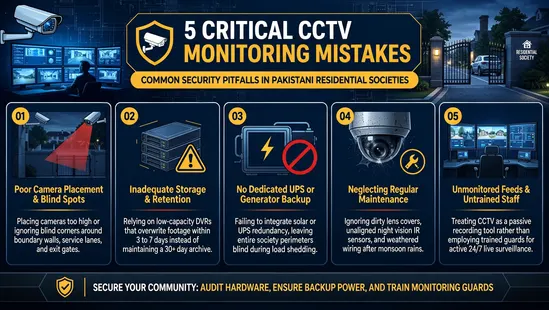
Direct answer: Most CCTV systems in Pakistan's residential societies underperform because of planning, not camera count. The five most common mistakes are adding cameras instead of fixing coverage gaps, storing footage in ways that can't be used as evidence, expecting one guard to watch dozens of feeds, ignoring resident privacy concerns, and running without a written monitoring policy. A coverage review, a retention and access policy, and clear ownership of footage review fix most of them.
Walk through most gated communities in Pakistan and you'll spot cameras on nearly every pole and gate. Yet break-ins, theft, and unresolved disputes still happen inside these same societies. The problem usually isn't a lack of cameras — it's how CCTV monitoring Pakistan residential societies actually get set up and run day to day.
This guide covers the five most common mistakes housing committees make, why they undermine security, and what to fix first.
## TL;DR
- Buying more cameras without fixing coverage gaps wastes budget and leaves entry points exposed.
- Footage that isn't stored or timestamped properly often can't be used as usable crime evidence.
- Relying on a single security guard to watch dozens of camera feeds guarantees most incidents go unnoticed.
- Ignoring resident privacy concerns creates disputes that can stall or shut down entire systems.
- No written maintenance or monitoring policy means the system quietly stops working until something goes wrong.
## Why CCTV Monitoring Pakistan Residential Societies Setups Underperform
**Direct answer:** Most residential society CCTV setups underperform because committees treat installation as a one-time purchase rather than an ongoing system that needs coverage planning, storage, and active monitoring.
A society can install forty cameras and still miss a break-in because the cameras cover the main gate twice while a side wall stays completely blind. Coverage planning, not camera count, is what actually determines whether a system works when it matters.
## Mistake 1: Buying More Cameras Instead of Fixing Coverage Gaps
The instinct after any incident is often to add cameras. But gated community security doesn't improve by stacking devices at the main entrance while boundary walls, parking areas, and service entrances stay unwatched.
A proper coverage review usually finds two or three critical blind spots per society — a back gate, a stairwell, or a parking corner — that matter far more than a fifth camera at the front gate. Committees exploring remote CCTV monitoring for gated communities often find that repositioning existing cameras solves more problems than buying new ones.
## Mistake 2: Storing Footage in a Way That Can't Be Used as Evidence
**Direct answer:** CCTV footage as crime evidence in Pakistan is often unusable in disputes or FIRs because it wasn't stored with correct timestamps, was overwritten before anyone reviewed it, or was recorded on a system with no chain of custody.
This is one of the most overlooked housing society CCTV rules Pakistan committees should follow. If footage from an incident is deleted within days because storage cycles automatically, there's no record left by the time residents or police request it. A basic retention policy — keeping footage for a defined period and preserving specific clips when an incident is reported — solves most of this. For societies deciding between storage types, comparing cloud vs local storage for CCTV footage is a useful first step before locking in a system.
## Mistake 3: Expecting One Guard to Monitor Dozens of Camera Feeds
Security guard vs CCTV monitoring debates often miss the real issue: it's rarely guards versus cameras, it's guards overloaded by too many cameras. A single person watching twenty or thirty live feeds on a wall of screens will miss most events in real time, no matter how alert they are.
This is where dedicated live security monitoring or trained remote monitoring teams make a measurable difference over an untrained guard splitting attention across a bank of monitors. Societies that pair cameras with virtual doorman services at entry points often see faster response times than those relying on a single on-site guard.
## Mistake 4: Ignoring Resident Privacy Concerns
CCTV surveillance privacy concerns Pakistan residents raise — cameras pointed into private balconies, windows, or shared corridors without clear rules — are usually dismissed early on and resurface later as formal complaints or disputes that stall the entire system.
A short, published policy prevents most of this: where cameras are placed, who can access footage, and how long it's retained. Framing surveillance as a shared safety measure rather than constant observation matters for resident trust, an idea echoed in ongoing public conversations about ethical surveillance and where reasonable limits on monitoring should sit (Dawn).
## Mistake 5: Running CCTV Without a Written Monitoring Policy
Most societies have no documented answer to basic questions: who reviews footage, how often, and what happens when something suspicious is spotted. Without this, cameras become passive recorders rather than an active security measure — a gap that has been noted in broader reporting on how surveillance cameras across Pakistan are frequently installed but not actively used to their full potential (Dawn).
A basic policy needs only a few elements:
- Who is responsible for daily or shift-based footage review
- What triggers an immediate response versus a routine log entry
- How incidents get documented and escalated to the committee
Societies already running CCTV monitoring for residential societies at scale typically formalize this policy alongside their benefits of CCTV monitoring for societies review, rather than treating it as a separate task.
## How to Choose CCTV for a Housing Society the Right Way
Fixing the five mistakes above starts with a proper selection process rather than picking whatever's cheapest or most heavily advertised. A reasonable approach looks like:
- Walk the full perimeter and mark every entry point, not just the main gate
- Budget for storage and monitoring, not just camera hardware and CCTV camera installation cost
- Decide who reviews footage and how often before installation, not after
- Choose systems with clear retention settings so footage survives long enough to matter
- Revisit coverage every year as the society layout, parking, or construction changes
For larger societies with multiple blocks or villa clusters, reviewing villas CCTV monitoring setups alongside shared common-area coverage avoids the common trap of securing individual homes while leaving shared spaces exposed.
## Summary
CCTV monitoring Pakistan residential societies setups fail more often from poor planning than from a lack of cameras. Coverage gaps, unusable footage storage, overloaded guards, ignored privacy concerns, and missing monitoring policies are the five mistakes that quietly undermine systems that otherwise look well-equipped on paper.
Fixing these issues doesn't require replacing an entire system — it requires a proper coverage review, a basic retention and access policy, and a clear answer to who's actually watching the footage. Housing committees that address these fundamentals get far more security value from the cameras they already have.
Frequently Asked Questions
How much does CCTV camera installation cost for a housing society in Pakistan?
Costs vary widely depending on camera count, coverage area, and whether footage is stored locally or in the cloud. Quotes based on an actual coverage plan, rather than a flat price per camera, give a more accurate budget.
Can CCTV footage be used as evidence in Pakistani courts?
Footage can support an FIR or investigation, but only if it's properly timestamped, kept long enough, and stored in a way that preserves its integrity. Poor storage is one of the biggest reasons footage becomes unusable later.
Is a security guard still necessary if a society has CCTV?
Yes, in most cases. Cameras record and can support live monitoring, but a guard can physically respond at entry points, which a camera can't. The two work best together, not as substitutes for each other.
How do housing societies handle resident privacy concerns about CCTV?
A published policy covering camera placement, who can access footage, and how long it's kept addresses most concerns. Keeping camera angles away from private windows and balconies is one of the simplest fixes.
What are the most commonly missed blind spots in residential societies?
Side and rear entrances, staircases, parking corners, and boundary walls away from the main gate. These are left uncovered most often, while entrances get duplicate coverage.
Do housing societies need a written CCTV monitoring policy?
In most cases it isn't legally required. Without one, though, footage review becomes inconsistent and incidents are more likely to go unnoticed until a resident complains.
How often should a society review its CCTV coverage?
At least once a year, or right after any layout change, such as new construction, added parking, or an incident that revealed a blind spot.
Put Trained Eyes on Your Society's Cameras, 24/7
Your society already has the cameras. GCCTVMS adds the missing piece: trained operators who watch your feeds live around the clock, log every incident, and preserve footage properly so it's there when residents, the committee, or police need it. **[Get a free coverage review for your society](https://gcctvms.com/contact)**
Get a Free QuoteCall +1 (501) 621-0002