




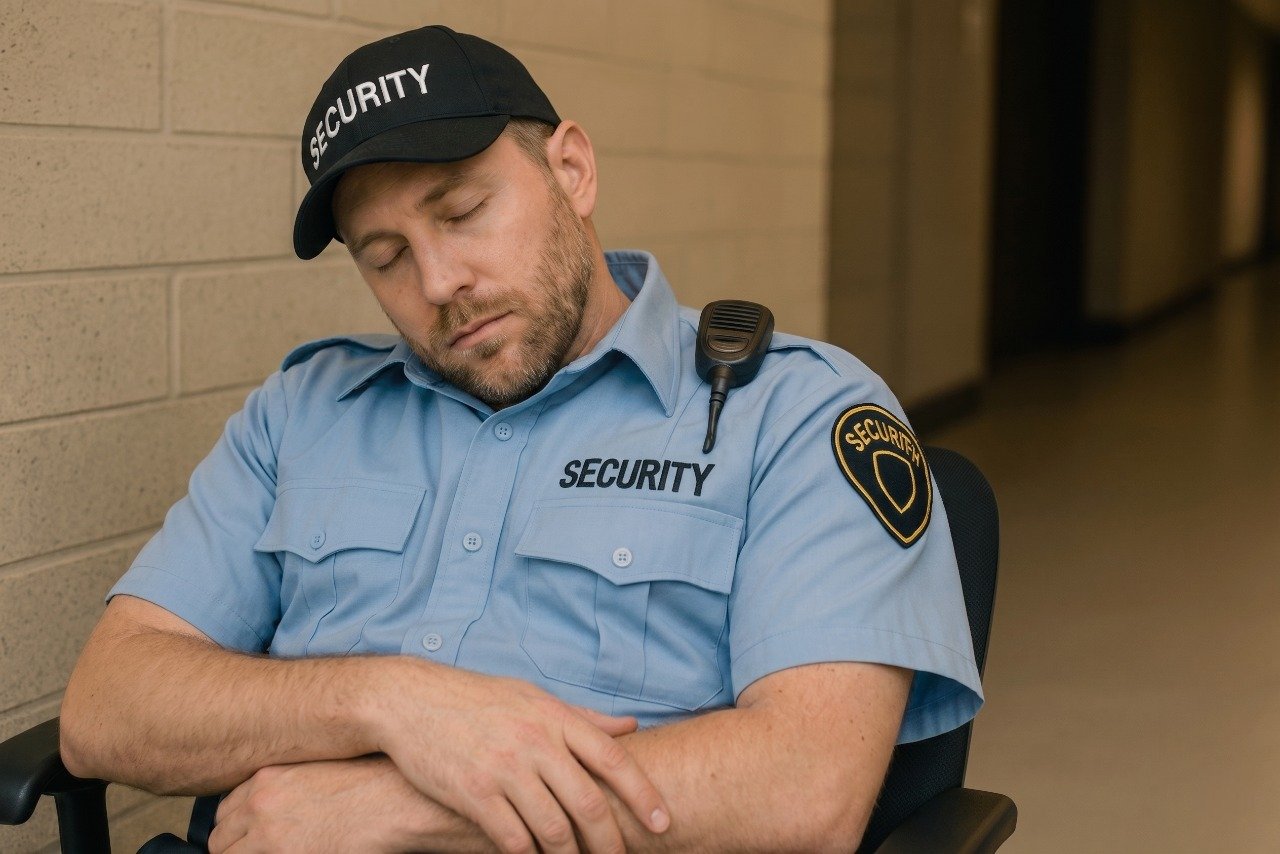
Security Guards Sleep, Cameras Don’t Care
TLDR; Security guards Sleep gets fatiguing on night shifts. Cameras record without responding. Neither option closes the gap between spotting a threat and stopping one. Live remote monitoring puts trained operators behind your existing cameras so threats get caught and acted on in seconds, not hours.
| Security Option | Core Failure | What It Actually Does |
| On-site security guard | Fatigue, single-point coverage, human error | Presence only — cannot cover all zones at once |
| Passive CCTV cameras | No operator, no response chain | Records events, does not stop them |
| Live remote monitoring | None of the above | Watches in real time and acts within seconds |
In February 2022, a distribution warehouse outside Birmingham lost £40,000 in cargo in under 12 minutes. Two guards were on shift that night. One was asleep at the front desk. The other was doing a perimeter walk on the opposite end of the property. Four cameras covered the loading bay. Every frame of the theft was recorded. Nobody called the police until 6 a.m.
The guards were not incompetent. They were human. And the cameras were not broken. They just had no one watching.
That is the security gap most businesses pay for without knowing it. They hire a guard because cameras feel passive. Or they install cameras because guards feel expensive. Either way, they end up with something that looks like security but does not act like it. The real question is not guards versus cameras. It is monitored versus unmonitored, and that distinction decides whether your business is protected or just documented.
The Assumption That Gets Businesses Robbed
Most business owners operate on one of two beliefs. The first: a guard on-site means someone is watching. The second: cameras on every wall mean everything is covered.
Both feel logical. Both fail the same way.
A guard is a single human being standing in one spot at a time. When they walk the east wing, nobody covers the west entrance. When they sit at the front desk at 3 a.m., their reaction time is not what it was at 10 p.m. That is not a discipline issue. That is biology.
A camera is a piece of hardware that captures light and stores it on a drive. It does not think. It does not call anyone. It does not care whether the person on screen is an employee or a burglar. Without a live operator behind the feed, that camera is doing exactly what a security guards sleep is doing: nothing.
The wrong mental model here is that presence equals protection. A guard’s presence and a camera’s presence both create the appearance of coverage. But appearance is not action. Action requires someone watching, recognizing a threat, and responding before the damage is done.
Security Guards Sleep Because That Is What Humans Do
This is not an accusation. It is a documented pattern across the industry. Night shift workers across every profession experience measurable cognitive decline after four to six hours on duty. Reaction time slows. Alertness drops. Decision quality degrades.
A guard working a 10 p.m. to 6 a.m. shift is fighting their own circadian rhythm the entire time. Studies on shift work performance consistently show that the window between 2 a.m. and 5 a.m. produces the lowest alertness scores of any working period. That is the exact window when most commercial break-ins happen.
Now add this: one guard covers one location. They cannot watch a parking lot and a loading dock and a front entrance at the same time. When they walk a perimeter, the areas behind them are unmonitored for the full duration of that walk. If a break-in starts at a point they just passed, they will not know until they circle back, or until they check the footage the next morning.
The cost of that single guard in the United States runs between $35,000 and $50,000 per year. For one person. Covering one site. With all the biological limitations that come with being human on an overnight shift.
And when businesses compare that cost against monitoring, the numbers tell a story the industry has been slow to acknowledge.
What Cameras Do When Nobody Watches
A camera without an operator behind it is a recording device. Nothing more.
When security guards sleep and the cameras keep running, those cameras capture every second of the incident. The footage is sharp. The angles cover the area. And the crime finishes without a single interruption. Because the camera was never built to interrupt. It was built to record.
The next morning, someone reviews the footage. They see the entry, the theft, the exit. They file a police report. The insurer requests the clips. If the resolution is high enough and the criminal was not wearing a mask, there is a chance of identification.
But the loss already happened. The merchandise is gone. The property damage is done. The business is paying the deductible, absorbing the downtime, and replacing whatever was taken. The camera gave them a recording. It did not give them protection.
This is the same failure pattern that showed up in the previous article on why most business CCTV systems prevent nothing. Cameras are a necessary layer. They are not a complete system. The watching is what makes them work.
The 60-Second Window That Decides Everything
Research on commercial burglary timing shows most break-ins are completed in under eight minutes. The entry itself takes less than two. That means the only window for stopping a crime, not just recording it, is the first 60 seconds after the perimeter is breached.
In those 60 seconds, a sleeping guard does nothing. An unmonitored camera records without alerting anyone. And the criminal, who has likely scouted the property, moves through the gap with full confidence that no one will respond in time.
Now compare that to a monitored system. A trained operator sees the breach on a live feed. Within 15 seconds, they confirm the threat. Within 30, they trigger an audio deterrent through on-site speakers. Within 45, they place a call to local authorities. By the 60-second mark, the criminal has heard a voice warning them they are being watched and recorded, and police dispatch is already in motion.
That is not a theoretical sequence. That is a standard operating protocol for remote guarding services that run 24/7 monitoring with human operators behind the feed.
The difference between these two outcomes is not better cameras or more guards. It is a live operator who is awake, trained, and watching at the exact moment the threat appears.
What Live Remote Monitoring Does That Neither Option Can
Remote monitoring solves both problems at once. It removes the fatigue variable from the guard model, and it adds a human response layer to the camera model.
Here is how it works in practice. A monitoring center employs trained operators who watch camera feeds from multiple client sites simultaneously. These operators work structured shift rotations designed for sustained alertness, not solo overnight marathons. When one operator’s shift ends, the next one picks up the feeds without a gap. There is no period where nobody is watching.
Research on real-time remote monitoring systems confirms what the operational model shows: a centralized monitoring team can cover more ground, with fewer blind spots, than distributed on-site personnel.
Each site has a defined response protocol. When the operator spots a threat, they follow a specific escalation sequence. Audio warning first. Police contact second. On-site emergency contact third. That sequence is agreed on during onboarding and documented so there is no improvisation during an actual incident.
A virtual security guard sleep does not sleep. Not because it is a machine, but because the system is designed so no single person carries an eight-hour solo watch. The monitoring never stops because the staffing model does not allow a gap.
The basics of how remote security monitoring works show the same principle: centralized, shift-rotated, protocol-driven response that outlasts any individual guard’s alertness window.
The Cost Comparison Nobody Wants to Have
Businesses resist this conversation because the guard feels like a fixed, known expense. One person, one salary, one location covered. The math feels simple.
But the math is misleading.
One guard covers one site for one shift. To cover a single location 24/7, you need a minimum of three full-time guards rotating shifts. That triples the cost. Add payroll taxes, insurance, management overhead, and replacement costs for turnover, and a single site’s guard expense can push past $120,000 per year.
Remote monitoring covers the same site, all cameras, all hours, for a fraction of that number. GCCTVMS pricing runs at $0.24 per camera per hour for businesses with fewer than 100 cameras. A 20-camera site monitored around the clock costs roughly $42,048 per year. That is less than a single guard’s fully loaded cost, and it covers every camera simultaneously, not just the one spot where a person happens to be standing.
For businesses with larger operations, the rate drops to $0.15 per camera per hour. The more cameras you run, the more the unit economics favor monitoring over physical presence.
Regional breakdowns for Pakistan and the United States show how these numbers work at the local level, including currency-adjusted comparisons that put guard costs against per-camera monitoring rates.
And the question that closes the comparison is always the same: is CCTV monitoring worth it? When the alternative is a guard who physically cannot stay alert for eight straight hours covering one zone, the answer is not complicated.
Why GCCTVMS Covers What Guards and Cameras Leave Open
GCCTVMS runs live security monitoring with trained human operators watching your feeds 24 hours a day. Not automated alert software. Not motion-triggered push notifications to a phone nobody checks at 3 a.m. Trained people, watching live video, acting on what they see.
When our operators confirm a threat, they follow your protocol. Audio deterrent through your on-site speakers. A direct call to police. A call to your emergency contact. Every step is documented in real time, and every incident produces a timestamped report you can hand to your insurer or law enforcement.
We operate across the USA, UK, Singapore, and Pakistan. We cover retail, warehouses, construction sites, commercial properties, and any business that runs cameras without anyone watching them.
The cameras you already own are not the problem. The gap is the watching. GCCTVMS fills it.
Book a free 30-minute call and we will walk through your current setup, identify where the blind spots are, and show you what monitored coverage looks like for your property.
Key Takeaways
- Security guards sleep fatigue on night shifts. Cognitive decline after four to six hours is documented, not anecdotal.
- A camera without a live operator records crime but cannot prevent it.
- The first 60 seconds of an incident determine whether a crime is stopped or just filmed.
- Remote monitoring removes the fatigue variable from guard coverage and adds a human response layer to passive cameras.
- One monitored system costs less than one full-time guard and covers every camera on your property simultaneously.
About the Author
By M. Huzaifa Rizwan
Content Writer │ SEO Executive │ Ads Expert
I write about CCTV monitoring, remote surveillance, and business security at GCCTVMS. My work covers SEO content production, ad strategy, and marketing operations across the USA, UK, Singapore, and Pakistan. Outside of GCCTVMS, I write on tech and lifestyle topics for TechSurges, Medium, and Substack.
FAQ’s
Why do security guards sleep on duty?
Night shift work fights the human circadian rhythm. After four to six hours on an overnight shift, alertness and reaction time drop significantly. This is a biological pattern documented across all professions, not a discipline failure specific to the security industry.
Can cameras replace security guards sleep entirely?
Cameras alone cannot replace guards because they lack the ability to respond. But cameras paired with live remote monitoring replace the watching and response functions of a guard while removing the fatigue, single-point coverage, and cost limitations that guards carry.
What happens during a break-in if no one monitors the cameras?
The cameras record the full incident. Nobody intervenes. The footage gets reviewed the next morning and filed with police or the insurer. The crime is documented but not prevented, and the loss is already complete.
What does live remote monitoring cost compared to a security guard?
A single full-time night guard in the US costs $35,000 to $50,000 per year and covers one location. Remote monitoring through GCCTVMS starts at $0.24 per camera per hour, meaning a 20-camera site costs roughly $42,048 per year with full coverage across every camera, every hour.
Does remote monitoring work with my existing camera system?
Yes. Remote monitoring connects to the cameras you already have installed. Operators watch your existing feeds from a monitoring center. The upgrade is the watching and response layer, not the hardware.
