





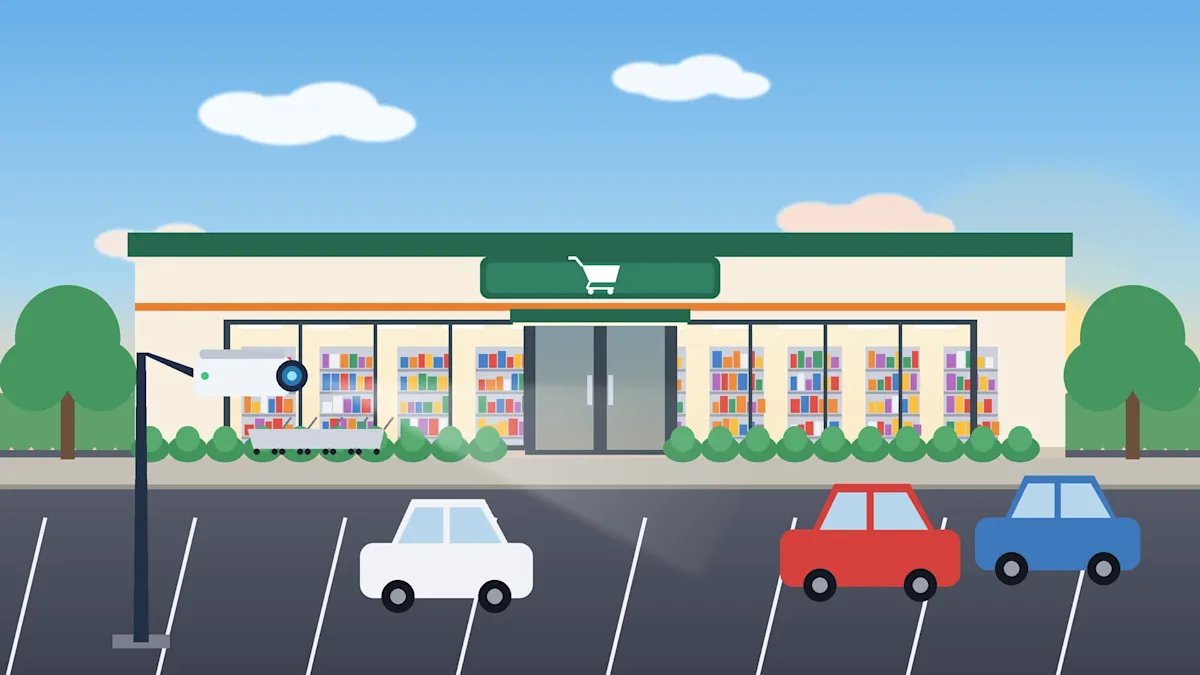
Direct answer: CCTV monitoring for supermarkets means trained operators at a remote center watch live camera feeds of aisles, self-checkout lanes, loading docks, parking lots and exterior ATM zones. They spot organized retail crime crews and self-checkout fraud while it’s happening, alert floor staff, dispatch police and trigger audio warnings, and they keep timestamped records for insurance and liability claims. It covers every camera at once, which in-store staff cannot.
CCTV Monitoring for Supermarkets: Stop Shoplifting, ORC Crews, and Employee Theft Before They Close Your Store
A brand new Whole Foods in San Francisco's Mid-Market neighbourhood closed after just one year of operation. Management cited theft and unsafe working conditions for staff. An Old Navy closed in the same city the same month. These were not small independent stores operating on thin margins. These were national chains with full security infrastructure making the calculated decision that the theft was unmanageable.
US retailers lost $132 billion to theft in 2024. Estimates for 2025 project $142 billion, a 7.3% increase. Stores are projected to lose $55 billion to retail theft by 2028. Shoplifting incidents rose 19% from 2023 to 2024, following a 26% jump the year before. 91% of retailers surveyed by the National Retail Federation in 2024 said aggression tied to shoplifting has increased.
Supermarkets face this crisis at the front line. Meat, seafood, alcohol, energy drinks, and confectionery are among the most stolen items in retail. These are supermarket staples. Unlike electronics retailers where high-value items can be locked behind glass, supermarkets stock high-theft items on open shelves throughout the store. They operate on net margins of 1% to 3%. A single theft event that costs $500 requires $20,000 to $50,000 in additional sales to recover.
CCTV monitoring for supermarkets addresses this by replacing cameras that record losses with operators who prevent them. GCCTVMS provides 24/7 live CCTV monitoring and camera monitoring services for supermarkets and grocery stores across the USA, UK, Singapore, and Pakistan.
What Supermarket Security Teams Assume vs. What Actually Happens
Most supermarkets have cameras. Hundreds of cameras in larger formats. Dome cameras in every aisle. PTZ cameras at entrances. Loss prevention staff reviewing flagged footage. The security infrastructure is visible and substantial.
Yet the losses continue. A San Francisco Giant Food store threatened closure due to shoplifting in 2023 despite all of this. The cameras recorded every theft. The footage was reviewed after each incident. Suspects were sometimes identified. Prosecutions were rare. The theft continued the next day.
This is the gap. Recorded CCTV documents what happened. CCTV monitoring for supermarkets stops what is happening.
Security Camera King's guide to CCTV in supermarkets explains how the shift from recording to live monitoring changes the outcome. An operator who watches a live feed can alert floor staff while the ORC crew is still at the shelf, before the merchandise reaches the exit. An operator who reviews footage after the fact produces a police report that rarely results in recovery.
GCCTVMS professional monitoring services and commercial surveillance add the trained live operator layer that converts your existing camera infrastructure from evidence collection to active prevention.
The Four Threats Supermarkets Face That Standard CCTV Cannot Stop
Organised Retail Crime: The $36 Billion Problem
Organised retail crime (ORC) accounts for nearly 36% of all retail theft. 76% of retailers in 2024 reported increased concern about ORC-related shoplifting. ORC crews do not grab one item and run. They work in coordinated groups. One crew member distracts the floor associate. A second fills a bag with high-value cuts from the butcher section. A third walks out through self-checkout scanning cheap items. The total loss from one ORC event at a supermarket runs $500 to $5,000 per incident.
ORC crews study camera coverage before they act. They know where the dome cameras point. They know which aisles have blind spots. They know that most supermarket CCTV records to a server that nobody reviews until the next day.
CCTV monitoring for supermarkets with live operators watching the floor changes this calculation. An operator who sees a group enter together, spread across multiple departments, and all arrive at self-checkout simultaneously knows what is happening before the first item walks out the door. Pavion's guide to grocery store security systems covers how integrated monitoring systems work in grocery retail environments. GCCTVMS live security camera monitoring and real-time security monitoring covers every aisle simultaneously.
Employee Theft and Self-Checkout Fraud
43% of Walmart's total annual losses are attributed to employee theft. That figure is not unique to Walmart. The grocery sector consistently reports employee theft as a top-three loss category. Cashiers who skip scanning items for friends. Back-room staff who walk out through delivery entrances with produce boxes. Department managers who process fraudulent voids. These losses accumulate quietly, in small amounts, over months.
Self-checkout has compounded the problem. Self-checkout fraud, where customers intentionally scan lower-cost items for higher-cost products or bag items without scanning, accounts for billions in annual losses. 73% of retailers noted more aggressive shoplifters during 2024, and self-checkout lanes are where organised groups concentrate their activity.
GCCTVMS video surveillance and commercial video surveillance monitoring covers self-checkout zones, back-room exits, delivery docks, and cashier stations with operators trained to identify both internal and external theft patterns.
Slip-and-Fall and Liability Claims
Supermarkets handle thousands of customers daily across wet produce sections, freshly mopped floors, and refrigeration condensation zones. Slip-and-fall claims are the most common liability issue supermarkets face. The average slip-and-fall settlement in a grocery store runs $15,000 to $50,000. Without timestamped video documentation, the store has no objective evidence of what the floor condition was at the moment of the alleged incident.
With CCTV monitoring for supermarkets covering every aisle and common area, every incident has a timestamped record. The footage shows whether the floor was wet, whether a wet floor sign was in place, and what the customer's behaviour was at the moment of the fall. Navco's guide on grocery store security services covers how incident documentation protects supermarkets from fraudulent and inflated claims.
GCCTVMS workplace incident report documentation produces liability-grade records for every incident.
After-Hours Break-Ins and ATM Theft
Supermarkets that close at 10 PM or midnight leave high-value inventory, cash offices, and in many cases ATMs accessible through the night. After-hours break-ins targeting supermarket cash offices and ATMs are documented across every market GCCTVMS serves. A single cash office breach costs $10,000 to $100,000. An ATM smash-and-grab causes $50,000 to $200,000 in damage and losses.
GCCTVMS night vision monitoring and remote monitoring and control covers supermarket perimeters, loading docks, and exterior ATM locations through every overnight hour. When an operator sees a vehicle approach the ATM zone at 2 AM, police are dispatched with a verified live incident before the first tool touches the machine.
Where Cameras Belong in a Supermarket
Every Aisle and High-Theft Product Zones
Meat sections, alcohol aisles, confectionery, energy drinks, health and beauty, and baby formula are the highest-theft zones. Dome cameras in ceiling at aisle endpoints cover wide angles. Mid-aisle cameras cover specific product shelves. CCTV monitoring for small business principles apply here: coverage starts at the product, not at the exit.
Self-Checkout Lanes
Self-checkout cameras need to cover the scanning area, the bagging area, and the customer's face simultaneously. A single overhead camera is insufficient. Two angles capture the full transaction interaction. Operators watching these feeds in real time catch both scanning fraud and bagging fraud as it happens.
Entrance, Exit, and Customer Service Counter
Entrance cameras at face height document every customer who enters. Exit cameras document every person leaving. Customer service counter cameras cover refund transactions and cash exchanges. GCCTVMS outdoor surveillance and video monitoring services cover all customer-facing zones.
Loading Docks and Back-of-Store
Loading dock cameras cover every delivery, every outbound waste removal, and every staff exit. Back-room cameras document inventory movement between delivery and the shop floor. These zones are where employee theft concentrates because they operate with minimal customer or management oversight.
Parking Lot and Cart Return Areas
Supermarket parking lots generate significant liability exposure. Customer assaults, vehicle break-ins, cart-related vehicle damage, and after-hours ATM attacks all concentrate in parking areas. GCCTVMS parking lot monitoring covers every parking zone with license plate capture at entry and exit points.
How CCTV Monitoring for Supermarkets Works in Real Time
Scenario 1: ORC Crew in Action. At 6:30 PM on a Saturday, an operator watching the meat section camera sees three people arrive at the butcher counter simultaneously. One engages the counter staff with questions. Two fill reusable shopping bags with premium cuts. The operator alerts the floor manager through the monitoring system. The manager intercepts the group at the self-checkout before any item leaves the store. Staff safely observe while police are dispatched. No confrontation. No loss.
Scenario 2: Self-Checkout Fraud Detection. At 3:15 PM on a Tuesday, the operator watching the self-checkout camera observes a customer repeatedly placing items in the bagging area without scanning. Over a 4-minute transaction, approximately $85 worth of product goes unscanned. The operator alerts the self-checkout attendant through the monitoring system. The attendant approaches and assists with a transaction review. The fraud is caught. The customer pays for the unscanned items.
Scenario 3: After-Hours ATM Attack. At 1:45 AM, the operator watching the exterior camera sees a flatbed truck back up to the ATM mounted on the building's exterior wall. Two people exit with chains. The operator immediately dispatches police and activates two-way audio surveillance through the building exterior: "This property is under live monitoring. Police have been dispatched. Leave immediately." The truck pulls away. Officers arrive within 4 minutes. The ATM is undamaged.
GCCTVMS provides surveillance monitoring and threat detection trained for supermarket-specific threat patterns including ORC, self-checkout fraud, and after-hours ATM attacks.
CCTV Monitoring for Supermarkets vs. Expanding Loss Prevention Staff
A dedicated in-store loss prevention officer costs $35,000 to $55,000 annually per location. That officer patrols one zone at a time. When they monitor the meat section, the self-checkout is unwatched. When they handle an incident at the front entrance, the back room is unsupervised.
GCCTVMS remote CCTV monitoring services cover every camera simultaneously for a fraction of that cost. Operators watch every aisle, every self-checkout lane, every loading dock, and every exterior camera at the same time. When a situation develops, the operator directs the nearest floor associate or loss prevention officer to the exact location with a description and context, making your existing team far more effective.
Most large supermarkets combine both: in-store loss prevention for physical response and CCTV monitoring for full-store awareness and coordination. GCCTVMS remote guarding services and business surveillance deliver the monitoring coverage that physical staff alone cannot provide.
Multi-Store Coverage for Supermarket Chains
Supermarket groups operating 10 to 500 locations need consistent security standards at every store. Separate monitoring systems at each location create reporting inconsistencies and coverage gaps. GCCTVMS provides outsource CCTV monitoring services and remote monitoring and control for multi-location supermarket groups from one monitoring centre. Every store gets the same operator training, response time, and incident report format. Loss prevention managers get consolidated reporting across the entire portfolio.
Insurance Benefits and Compliance
Supermarket insurance premiums are directly influenced by documented security measures. Most commercial property insurers offer 5% to 15% premium reductions for supermarkets with verified live security camera monitoring. For a chain paying $500,000 annually in commercial property insurance, a 10% reduction saves $50,000 per year.
GCCTVMS camera monitoring services produces insurance-grade documentation for every incident, dispatch, and resolution.
How GCCTVMS Monitors Supermarkets
GCCTVMS connects to your existing camera system. Any brand. Any supermarket size. A single independent grocery store or a 300-location national chain. We add trained operators who watch your feeds around the clock.
Our operators understand grocery retail. They know what ORC staging looks like in a meat section. They know what self-checkout fraud looks like across a 4-minute transaction. They know that a vehicle at the ATM at 1:45 AM is not a customer making a withdrawal. They alert your team, dispatch police, and document every incident with the timestamps your loss prevention and legal teams need.
GCCTVMS provides CCTV monitoring for supermarkets across single locations and multi-store portfolios. USA, UK, Singapore, and Pakistan coverage from one monitoring centre. Sub-60-second response time. Full incident documentation.
Contact our team to discuss monitoring for your supermarket, or get a free 30-min call to review your current camera coverage and security gaps.
Frequently Asked Questions
What is CCTV monitoring for supermarkets?
CCTV monitoring for supermarkets means trained operators at a remote centre watch live camera feeds covering every aisle, self-checkout lanes, loading docks, back rooms, parking lots, and building perimeters. They detect ORC crews, self-checkout fraud, employee theft, and after-hours break-ins in real time and respond with staff alerts, audio warnings, and police dispatch
How much do supermarkets lose to theft annually?
US retailers lost $132 billion to theft in 2024. Estimates for 2025 project $142 billion. Shoplifting incidents rose 19% from 2023 to 2024. Supermarkets are among the hardest-hit retail categories because high-theft items like meat, alcohol, and health and beauty products sit on open shelves.
How does CCTV monitoring stop organised retail crime in supermarkets?
Operators watching store cameras in real time detect ORC crew coordination patterns before merchandise leaves the store. Multiple individuals spreading across departments and converging on self-checkout simultaneously is a recognisable pattern. Operators alert floor staff while the crew is still at the shelf, not at the exit.
Does CCTV monitoring catch self-checkout fraud?
Yes. Operators watching self-checkout camera feeds observe scanning behaviour in real time. Item placement in the bagging area without scanning, and scanning cheaper items for more expensive ones, are both detectable patterns that trigger an alert to the self-checkout attendant.
How does CCTV monitoring protect supermarkets from liability claims?
Timestamped footage documents floor conditions, wet floor sign placement, and customer behaviour at the moment of any incident. This evidence resolves slip-and-fall disputes with objective documentation rather than competing accounts.
What does CCTV monitoring cost for a supermarket?
CCTV monitoring services for supermarkets cost $300 to $1,000 per month depending on store size, camera count, and coverage hours. Compare that to $35,000 to $55,000 annually for one in-store loss prevention officer who covers one zone at a time.
Can one CCTV monitoring service cover a supermarket chain?
Yes. GCCTVMS provides remote CCTV monitoring services for multi-location supermarket groups from one monitoring centre. Every store gets the same operator training, response time, and incident report format. Loss prevention managers receive consolidated reporting across the entire portfolio.
Does CCTV monitoring help with supermarket insurance premiums?
Yes. Commercial property insurers offer 5% to 15% premium reductions for supermarkets with documented live security camera monitoring. For a chain paying $500,000 annually in insurance, the saving covers significant monitoring costs.
How does CCTV monitoring cover supermarkets after hours?
Operators watch exterior cameras, loading docks, and ATM zones through every overnight hour. Break-in attempts and ATM attacks trigger immediate police dispatch with a verified live incident report. The response starts at the perimeter, not 15 minutes later through an alarm company call chain.
Does GCCTVMS connect to existing supermarket camera systems?
Yes. GCCTVMS connects to any existing camera brand and infrastructure without requiring hardware replacement. Operators begin monitoring your supermarket feeds once the connection is configured.
Get a Monitoring Plan for Your Property
Tell us about your site, your cameras and your risk hours. We'll send you a coverage plan and a monthly quote for your site.
Get a Free QuoteCall +1 (501) 621-0002