





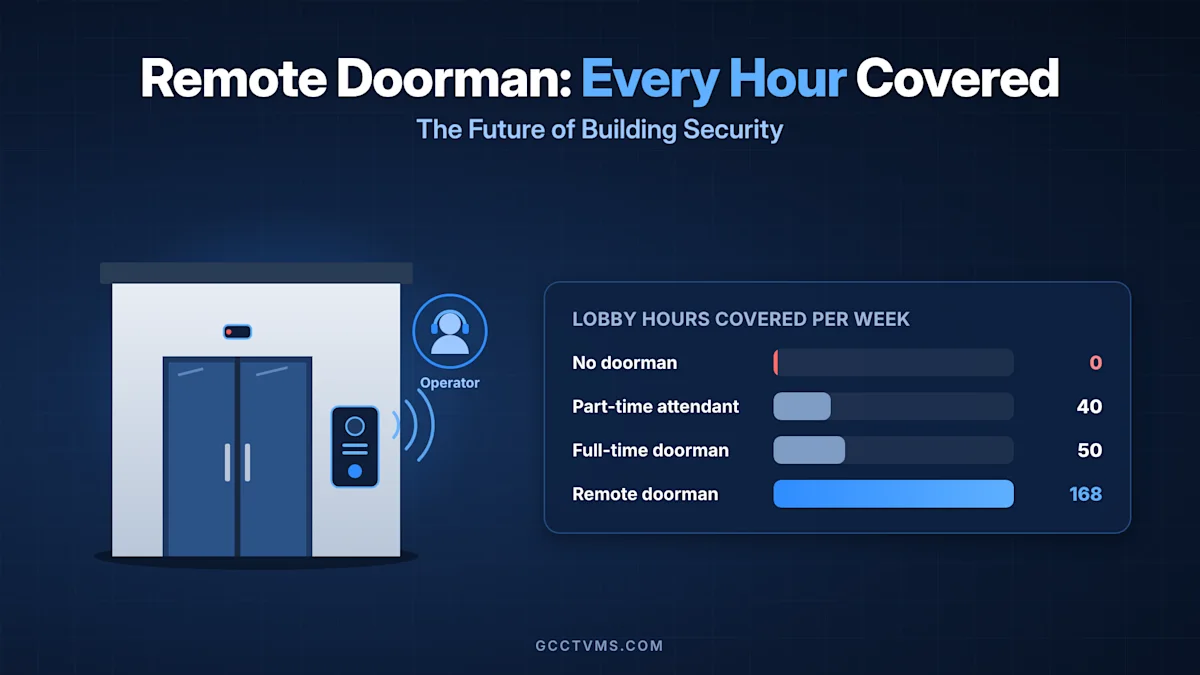
Direct answer: A remote doorman is a trained operator who screens visitors, controls access, logs deliveries, manages vendor entry and coordinates emergencies from a monitoring center, using live cameras and a two-way intercom. Buildings with no doorman leave the entrance unguarded every hour, and buildings with a traditional doorman leave it unguarded at night, at weekends and on holidays. A remote doorman covers all 168 hours a week at a fraction of the cost of staffing the lobby in person.
Remote Doorman: What Buildings Without One Are Getting Wrong
TLDR A remote doorman screens visitors, controls access, manages deliveries, and handles emergencies from a monitoring center through live cameras and two-way intercoms. Buildings without any doorman coverage leave their entrance unguarded for every hour of every day. Buildings with a traditional doorman leave it unguarded for nights, weekends, and holidays. A remote doorman covers every hour at a fraction of the cost and handles every function a lobby attendant performs without being physically present.
| Building Setup | Hours Covered | Annual Cost | Coverage Gap |
| No doorman | 0 hours | $0 | Every hour of every day |
| Part-time lobby attendant | 40 hours/week | $25,000 -- $35,000 | 128 hours/week unguarded |
| Full-time traditional doorman | 50 hours/week | $60,000 -- $100,000 | Nights, weekends, holidays |
| Remote doorman | 168 hours/week | $3,600 -- $12,000 | None |
A property manager in Philadelphia ran a 120-unit apartment building with a part-time lobby attendant who worked Monday through Friday, 8 a.m. to 4 p.m. The attendant handled visitor screening, packages, and vendor access during those 40 hours. The remaining 128 hours each week, the lobby was empty.
On a Saturday night at 11:30 p.m., a man followed a resident through the front door. He walked directly to the fourth floor, tried three apartment doors, and found one unlocked. The resident inside was asleep. The man took a laptop, a wallet, and car keys from the kitchen counter and left through the same entrance he came in. The lobby camera recorded his face, his entry, and his exit. Nobody watched the footage until Monday morning.
The building had a security camera. It did not have a remote doorman. That single difference is what separates a building that records crimes from a building that prevents them at the entrance.
What a Remote Doorman Actually Does
A remote doorman is a trained operator working from a monitoring center who handles every function a traditional lobby attendant handles, through live cameras and a two-way intercom system instead of a physical desk.
When a visitor approaches the building entrance and presses the intercom, the operator sees them on camera, speaks to them directly, verifies who they are visiting, contacts the resident for confirmation, and either grants or denies access. The process takes under 30 seconds. The visitor is screened before they enter the building, not after.
That is one function. The full remote doorman service covers visitor screening, package delivery logging, vendor and contractor access management, emergency coordination, and common area monitoring. Every action is timestamped and documented. Every interaction is recorded. The operator watches the lobby, entrance, hallways, and common areas through live camera feeds and responds to anything that requires attention.
The step-by-step process of how a virtual doorman works breaks down the technology stack: lobby cameras, intercom hardware, electronic door locks, and the monitoring platform that connects all three to the operator's station. The hardware sits in the building. The operator sits at the monitoring center. The resident sees the same result as a traditional doorman answering the door.
The Coverage Problem Buildings Cannot Solve With Staff
A traditional doorman works a shift. When the shift ends, the lobby is empty. A full-time doorman working 50 hours per week covers 30% of the week. The remaining 70% of hours, including every night, every weekend, and every holiday, have no coverage.
The remote concierge market has expanded precisely because of this coverage gap. Buildings that can afford one shift of doorman coverage cannot afford three shifts. Buildings that cannot afford any doorman coverage run completely unguarded entrances. In both cases, the majority of hours are uncovered.
A remote doorman eliminates the coverage gap entirely. The monitoring center operates 24 hours a day, 7 days a week. Operator shifts rotate so the entrance is always watched. There is no gap between shifts, no sick days without coverage, and no holidays without someone at the screen.
The cost comparison makes the coverage gap even harder to justify. A single full-time traditional doorman costs $60,000-$100,000 per year. Three doormen rotating to cover all 168 hours per week cost $180,000-$300,000. A remote doorman covering all 168 hours costs $3,600-$12,000 per year. The cost and coverage comparison between virtual doorman and traditional security runs in one direction regardless of building size.
Five Functions a Remote Doorman Handles From a Monitoring Center
Visitor Screening and Access Control
Every person who approaches the entrance is seen on camera before they enter the building. The operator speaks to them through the intercom, verifies their identity, contacts the resident, and grants or denies access through the electronic lock. Nobody enters without being screened.
A remote access control system managed by a live operator is more reliable than a key fob or buzzer system managed by nobody. A key fob can be copied. A buzzer can be answered by a resident who does not check who they are letting in. A remote doorman checks every time.
Package and Delivery Management
The operator watches every delivery arrive on camera, logs the package with a timestamp, and notifies the resident. If a package is left in the lobby unattended, the operator flags it. If someone who is not the resident picks up a package, the operator sees it in real time and acts.
Package theft in apartment lobbies is a logistics problem that buildings without a doorman cannot solve with cameras alone. A camera records the theft. A remote doorman prevents it by watching the lobby and flagging unauthorized pickups as they happen.
Vendor and Contractor Access
When a maintenance worker, cleaner, or contractor arrives at the building, the operator verifies their identity and purpose against a pre-approved access list. The operator logs the entry time and monitors when the vendor leaves. If a vendor does not leave by the expected time, the operator flags it with building management.
A building without access management has no record of who entered, when they entered, or when they left. A remote doorman creates that record for every vendor visit, which protects both the building and the property management company.
Emergency Coordination
When a fire alarm, medical emergency, or security incident happens at 3 a.m. in a building with no doorman, the resident handles it alone. Nobody unlocks the entrance for paramedics. Nobody guides first responders to the correct unit. Nobody notifies building management until morning.
A remote doorman operator handles emergency coordination in real time. They contact emergency services, unlock the entrance for first responders, guide them through the intercom, and notify building management simultaneously. That coordination happens at any hour because the operator is always watching.
Common Area Monitoring
The operator watches hallways, stairwells, laundry rooms, parking areas, and rooftops through live camera feeds. A propped door gets flagged. Loitering in a stairwell gets flagged. A person entering through a side entrance without using the intercom gets flagged.
The seven ways a virtual doorman improves building security include common area monitoring as one of the highest-value functions for residential properties. A camera in a hallway without someone watching it is a recording device. A camera with a remote doorman behind it is an active security system.
Remote Concierge vs. Remote Doorman vs. Remote Guard
Three terms appear across the industry and they overlap enough to cause confusion.
A remote concierge service handles visitor reception, resident communication, and service coordination. The focus is hospitality and convenience.
A remote doorman handles access control, visitor screening, and security monitoring. The focus is building security and entry management.
A remote guard service handles perimeter monitoring, threat detection, and police dispatch. The focus is active security response.
In practice, a remote doorman combines elements of all three. The operator screens visitors (concierge function), controls access (doorman function), and monitors cameras for threats (guard function). The concierge model explained by CIE Group shows how these roles converge in a single monitoring station.
For residential buildings, the remote doorman label is the most accurate because the primary function is controlling who enters and exits the building. The concierge and guard functions are secondary but included.
What Buildings Get Wrong Without a Remote Doorman
Buildings without any form of doorman coverage make five specific mistakes that a remote doorman prevents.
Unscreened entry. Anyone who follows a resident through the front door enters the building without identification. Tailgating is the most common unauthorized entry method in residential properties and it is invisible without someone watching the entrance.
Untracked packages. Deliveries sit in the lobby with no record of when they arrived or who picked them up. When a package goes missing, there is no log and no footage review until someone files a complaint.
No vendor accountability. Contractors enter and exit without documentation. If property goes missing or damage occurs during a vendor visit, there is no record of who was in the building or when they left.
Emergency response gaps. A resident having a medical emergency at 2 a.m. calls 911 and waits for paramedics to figure out which entrance is accessible. Nobody unlocks the door. Nobody meets the ambulance.
Liability exposure. An unmonitored lobby with no access control, no visitor logs, and no incident documentation is a liability for the property management company. When an incident happens and the insurer or attorney asks what security measures were in place, the answer is "cameras that nobody watches."
The traditional doorman role addresses every one of these problems during working hours. A remote doorman addresses them during every hour.
How to Choose the Right Remote Doorman Provider
Three factors separate a reliable remote doorman provider from a notification service pretending to be one.
Response time. When a visitor presses the intercom, the operator should answer within 10-15 seconds. If the average response time is over 30 seconds, residents will stop using the intercom and start buzzing everyone in. Ask for documented response time averages, not promises.
Operator quality. The operator is the voice and face of the building's security. They need to handle confrontational visitors, confused delivery drivers, and panicked residents with professionalism. Ask whether operators are trained specifically for residential access management or whether they are general call center staff handling doorman duties as a side function.
System integration. The remote doorman platform needs to work with your existing intercom, cameras, and electronic locks. A provider that requires a full hardware replacement to start service is selling a system, not a service. The complete guide to choosing virtual doorman services covers evaluation criteria in detail.
Why GCCTVMS Remote Doorman Service Covers What an Empty Lobby Cannot
GCCTVMS provides virtual doorman services with trained operators watching your building's entrance, lobby, and common areas 24 hours a day. When a visitor presses the intercom, our operator answers within seconds, screens the visitor, confirms with the resident, and grants or denies access.
We handle package logging, vendor access tracking, emergency coordination, and incident documentation as part of every remote doorman engagement. Every action is timestamped. Every interaction is recorded. Every hour is covered.
Our system integrates with your existing intercom hardware, cameras, and electronic locks. The upgrade is the monitoring and response layer, not a full equipment replacement.
GCCTVMS operates remote doorman services across the USA, UK, Singapore, and Pakistan. Whether you manage a 30-unit walkup or a 200-unit high-rise, the service scales to your building and your budget.
Your entrance is either guarded or it is not. A remote doorman makes it guarded.
Book a free 30-minute call and we will review your building's access points, intercom setup, and camera positions to show you what remote doorman coverage looks like for your property.
Key Takeaways
- A remote doorman handles visitor screening, access control, package management, vendor tracking, and emergency coordination from a monitoring center through live cameras and two-way intercoms.
- Buildings with a traditional doorman cover 30% of the week. Buildings with a remote doorman cover 100% of the week at 5-10% of the cost.
- The five problems buildings face without a remote doorman are unscreened entry, untracked packages, unaccountable vendors, emergency response gaps, and liability exposure.
- A remote doorman combines concierge, doorman, and guard functions in a single monitoring station.
- The service integrates with existing building hardware. The upgrade is the watching and response layer, not a system replacement.
Frequently Asked Questions
What is a remote doorman?
A remote doorman is a trained operator who monitors a building's entrance through live cameras and communicates with visitors through a two-way intercom. The operator screens visitors, controls access, logs deliveries, manages vendor entry, and coordinates emergencies from a monitoring center without being physically present in the lobby.
How much does a remote doorman cost compared to a traditional doorman?
A remote doorman costs $3,600-$12,000 per year and covers all 168 hours per week. A traditional full-time doorman costs $60,000-$100,000 per year and covers one shift. Full 24/7 traditional coverage with three rotating doormen costs $180,000-$300,000 per year.
Can a remote doorman work with my building's existing intercom?
Yes. Most remote doorman services integrate with existing intercom hardware, cameras, and electronic locks. The monitoring center connects to your current equipment remotely. If upgrades are needed, they are typically limited to adding a camera at the entrance or updating the intercom unit, not replacing the full system.
What is the difference between a remote doorman and a remote concierge?
A remote doorman focuses on building security: visitor screening, access control, and threat monitoring. A remote concierge focuses on hospitality: resident services, visitor reception, and communication. In practice, most remote doorman services include concierge functions as part of the standard coverage.
Does a remote doorman handle emergencies?
Yes. When a medical emergency, fire, or security incident occurs, the operator contacts emergency services, unlocks the entrance for first responders, guides them to the correct location via intercom, and notifies building management. This coordination happens at any hour because the monitoring center is always staffed.
See What Remote Doorman Coverage Looks Like for Your Building
Book a free 30-minute call and we will review your building's access points, intercom setup, and camera positions to show you what remote doorman coverage looks like for your property. **[Book your free 30-minute call](https://gcctvms.com/contact)**
Get a Free QuoteCall +1 (501) 621-0002