





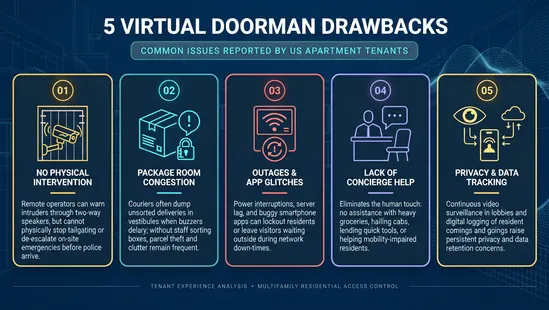
Direct answer: The five drawbacks tenants report most often with virtual doorman service in US buildings are privacy concerns around facial recognition, slower emergency response than a doorman on-site, technical glitches and downtime, the loss of a personal relationship with building staff, and a poor fit for some buildings and resident groups. None of these rule virtual doormen out, but they mean the decision shouldn't rest on cost alone. Clear data policies, reliable providers and hybrid staffing address most of them.
5 Virtual Doorman Service in USA Drawbacks Tenants Often Report
Buildings across the US are swapping front-desk staff for cameras, intercoms, and remote operators. It's cheaper to run and available around the clock, but a virtual doorman service in USA buildings doesn't satisfy every resident the way a person at the desk once did.
This article covers the five drawbacks tenants bring up most often, why they matter, and what buildings can do to address them.
TL;DR
- Facial recognition and constant camera coverage raise real privacy concerns for some residents.
- Emergency response can be slower when there's no one physically present to react immediately.
- Technical glitches — frozen intercoms, delayed video feeds — are a recurring tenant complaint.
- Losing the personal relationship with a familiar doorman is a genuine, if less measurable, downside.
- Not every building or resident population is a good fit for a fully remote setup.
Why Virtual Doorman Service in USA Buildings Draws Mixed Reactions
Direct answer: Virtual doorman service in USA buildings draws mixed reactions because it solves real cost and coverage problems for landlords while introducing new privacy, reliability, and personal-connection concerns for tenants.
Property managers like the economics: one remote team can cover multiple buildings, and coverage doesn't stop for sick days or shift changes. Tenants, meanwhile, are the ones dealing with the day-to-day trade-offs — which is why the same handful of complaints keeps surfacing across different buildings and cities.
Drawback 1: Facial Recognition and Privacy Concerns
Facial recognition apartment building privacy concerns are consistently the most reported issue with virtual doorman systems. Cameras that scan faces to grant entry, log visitors, or flag "unknown" people raise questions about how that data is stored, who can access it, and how long it's kept.
Reporting from ABC7 New York found that some New York City tenants have raised concerns about virtual doorman systems collecting facial recognition data without clear consent processes in place. Buildings considering virtual doorman services with facial recognition features should be prepared to explain data retention and opt-out options clearly, not just installation benefits.
Drawback 2: Slower Emergency Response Than a Physical Doorman
Direct answer: Emergency response can be slower with a virtual doorman because a remote operator has to assess a situation through cameras and intercoms before deciding how to act, compared to a person on-site who can respond immediately.
A traditional doorman standing at the entrance can physically intervene, call for help, or assist someone in distress within seconds. A remote operator watching a screen has to interpret the situation first, which adds delay even when the response is otherwise appropriate. This is one of the clearest points raised in ongoing comparisons of virtual doorman vs traditional security approaches for residential buildings.
Drawback 3: Technical Glitches and System Downtime
24/7 virtual security monitoring only works as well as the technology behind it. Frozen video feeds, intercoms that fail to connect, or a laggy app during a package delivery are common frustrations tenants mention, and they're avoidable failure points that a human doorman simply doesn't have.
Buildings can reduce this by choosing systems with redundant connectivity and a documented uptime record before relying on them as the sole entry point. Reviewing common remote doorman mistakes to avoid during setup, rather than after residents start complaining, prevents most of these issues from becoming a pattern.
Drawback 4: Losing the Personal Relationship With Building Staff
Video intercom apartment security solves access control, but it doesn't replicate the small, recurring interactions residents build with a familiar doorman — someone who recognizes them, holds packages, or simply says good morning. CooperatorNews has covered how technology greeting residents at the door changes the character of a building, even when the security functions themselves work fine.
This isn't a functional drawback so much as a cultural one, but it's real enough that some buildings choose a hybrid model — a remote concierge apartment service for after-hours coverage, paired with in-person staff during peak times — rather than going fully remote.
Drawback 5: Not Every Building Is a Good Fit
Virtual doorman vs traditional doorman decisions often get made based on cost alone, without considering whether the building's resident population, layout, or entry points actually suit a remote setup. A high-traffic building with multiple entrances, frequent deliveries, and older residents less comfortable with app-based access may see more friction than a smaller, single-entrance building with a tech-savvy tenant base.
Before switching, it's worth walking through how a virtual doorman would actually work in day-to-day scenarios — package rooms, guest access, and maintenance visits — rather than assuming one system fits every property. How does a virtual doorman work guides can help buildings map this out before signing a contract.
Remote Doorman System Cost vs. Traditional Staffing
Remote doorman system cost is usually the deciding factor for property managers, and the savings are real — one remote team can cover several properties instead of paying for round-the-clock staff at each one. But cost comparisons should also account for the drawbacks above, since resolving privacy complaints, adding backup systems for downtime, or maintaining a hybrid staffing model all add expenses that a bare cost comparison often leaves out.
Buildings comparing options can review the complete list of virtual doorman responsibilities and duties to understand exactly what's included before assuming a lower monthly cost covers the same scope as full-time staff.
How to Choose the Best Virtual Doorman Provider
For buildings that decide a virtual doorman still makes sense despite these drawbacks, the provider matters more than the technology alone. Look for:
- Clear, published data retention policies for any facial recognition or video data
- Documented response-time benchmarks for emergencies, not just marketing claims
- Redundant connectivity to reduce outages during peak hours
- Support for a hybrid model if full remote coverage doesn't fit the building
- References from similar-sized properties, not just case studies from very different buildings
Guides on how to choose the best virtual doorman provider for your property are a useful starting point for building a shortlist before requesting demos.
Summary
A virtual doorman service in USA buildings offers real cost savings and round-the-clock coverage, but it comes with trade-offs that tenants notice quickly: privacy concerns around facial recognition, slower emergency response than a person on-site, occasional technical glitches, the loss of a familiar face at the door, and mismatches between the technology and certain buildings' needs.
None of these drawbacks make virtual doorman systems a bad choice outright — they simply mean the decision shouldn't be based on cost alone. Buildings that address data privacy clearly, choose reliable providers, and consider a hybrid staffing model where it makes sense tend to see far fewer complaints than those that switch without planning for these gaps.
Frequently Asked Questions
Is a virtual doorman as safe as a traditional doorman?
It depends on the building and the quality of the system. Virtual doorman systems handle access control and monitoring well, but emergency response can be slower because a remote operator has to assess the situation before acting, unlike staff standing at the entrance.
Do virtual doorman systems store facial recognition data?
Many do, for access control and visitor logs, though retention policies vary by provider. Tenants who are concerned should ask building management directly what data is collected and how long it's kept.
How much does a virtual doorman system cost compared to staffed doormen?
Virtual systems are generally cheaper because one remote team can serve several buildings. Exact costs depend on the number of entry points, the camera coverage, and whether facial recognition or intercom features are included.
Can tenants opt out of facial recognition in their building?
That depends on the building and the provider. Some systems offer other ways in, such as key fobs or codes, but this isn't available everywhere, so confirm it with property management before you move in.
What happens if the virtual doorman system goes down?
Most buildings have a backup way in, such as a physical key or fob, for outages. Downtime can still disrupt package deliveries, guest access, and intercom calls until the system is back up.
Are virtual doormen replacing traditional doormen entirely?
Not everywhere. Many buildings use a hybrid model, with virtual coverage overnight or at quiet times and in-person staff during busy hours.
Do virtual doorman systems work well for older or less tech-comfortable residents?
It varies. Buildings with many residents who aren't used to app-based access sometimes get more complaints and support requests, so factor that in before moving entirely away from in-person staff.
A Virtual Doorman Run by Real People, Not Just Software
The gaps tenants report usually come down to how a virtual doorman is run, not the idea itself. GCCTVMS pairs your building's cameras and intercoms with trained live operators around the clock, so visitors are verified, incidents are escalated quickly, and residents always reach a person when they need one. **[Talk to us about virtual doorman coverage for your building](https://gcctvms.com/contact)**
Get a Free QuoteCall +1 (501) 621-0002